What Latvian law requires
In Latvia winter tyres are compulsory from 1 December to 1 March on vehicles and buses with a gross weight of up to 3500 kg. CSDD puts it without any qualification: during that period summer tyres have no business being on the road.
Since 1 October 2024 it is no longer enough for a tyre to be called a winter tyre. Only a tyre carrying the 3PMSF marking, the mountain and snowflake symbol on the sidewall, counts as one, and the requirement comes from amendments to Cabinet Regulation No. 295, as LV portāls explains. There is no mandatory test behind the old M+S marking, so CSDD no longer accepts it during the winter period and a car on such tyres will not pass its roadworthiness test. Outside the compulsory period, from 2 March to 30 November, M+S tyres are perfectly fine to drive on.
The minimum tread depth in winter is 4 mm for passenger cars and lorries up to 3.5 t, 3 mm for buses over 3.5 t and 2 mm for lorries over 3.5 t (CSDD). The fine for driving without suitable winter tyres during the compulsory period is six penalty units, or 30 euros, and it is set by paragraph fourteen of section 71 of the Road Traffic Law.
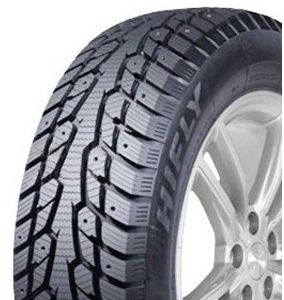
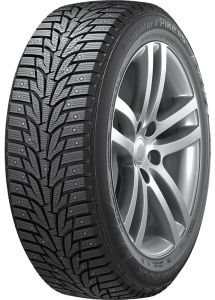
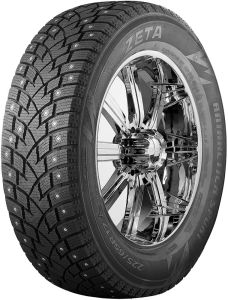
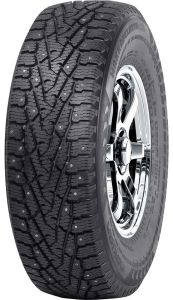
Studs have a calendar of their own: from 1 October to 1 May. CSDD also points out that studded and studless tyres must not be mixed on the same car, which is why studded tyres are only ever bought as a full set of four.
Studded or studless (friction) tyres
This is the first choice to make, and the brand comes only after that. Both types are proper winter tyres with different working ranges, and the figures from independent tests show that clearly enough. The braking and noise figures in the table come from the Vi Bilägare category comparison and the 2025 Tekniikan Maailma and UTAC test, the aquaplaning data from the Teknikens Värld 2025 test, and the seasonal requirements in the three Baltic states from the European Consumer Centre.
| Criterion | Studded | Studless (Nordic friction) |
| Ice, braking | 9.9 m from 25 km/h (Vi Bilägare); 32.3 m from 50 km/h for the best one (Tekniikan Maailma 2025) | 11.06 m from 25 km/h; 33.1 m from 50 km/h for the best one |
| Packed snow | 17.74 m from 40 km/h | 17.56 m from 40 km/h |
| Wet asphalt | 30.06 m from 80 km/h | 31.58 m from 80 km/h |
| Dry asphalt | 46.54 m from 100 km/h | 45.1 m from 100 km/h |
| Slush and aquaplaning | Weaker than studless tyres | Better than studded tyres, but below the level of Central European tyres: 55.7-64.6 km/h against 76.8 km/h in straight-line aquaplaning |
| Noise | 70.1 dB | 66.2 dB |
| Wear and effect on the road surface | Studs abrade the asphalt and stir up road dust | Does not damage the road surface |
| Requirements and season in Latvia | Permitted from 1 October to 1 May | Permitted all year; winter period 01.12.-01.03., minimum tread 4 mm |
| Requirements and season in Lithuania | Banned from 10 April to 1 November | Permitted all year; winter period 10.11.-01.04., minimum tread 3 mm |
| Requirements and season in Estonia | Permitted from 15 October to 31 March, and in winter conditions exceptionally until 30 April | Permitted all year; winter period 01.12.-01.03., minimum tread 3 mm |
Who needs which. Studs earn their money for anyone who regularly drives ungritted country and gravel roads in winter, over hills, or sets off in the morning ahead of the gritter. In Vidzeme and Latgale they are still a sensible choice. For most drivers, though, a studless tyre is the better buy: the city, a gritted motorway and cold wet asphalt. It is quieter, and on dry asphalt it brakes in a shorter distance. More important still, the spread within a single category is wider than the gap between the two types. In the Tekniikan Maailma test the worst studless tyre needed 53.3 m on ice where the best one stopped after 33.1 m. Some models can be studded on request, but ready-made studded tyres are collected in a section of their own.
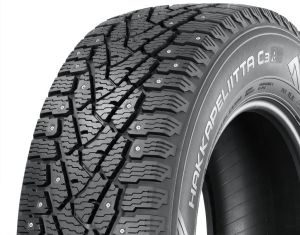
Nordic and Central European winter tyres
Both are 3PMSF tyres and both are legal in Latvia; only the rubber recipe is different. The Nordic compound is soft and meant for ice and packed snow, while the Central European, or Alpine, tyre is harder, with a higher speed rating and better water dispersal, because winter there means a cold wet motorway.
On ice the difference is large. In the Vi Bilägare category comparison the Central European winter tyre stopped from 25 km/h after 14.15 m, while the Nordic studless tyre needed 11.06 m. In the Teknikens Värld 2025 test the Central European group was judged inadequate on ice, even though it was outstanding on dry and wet surfaces: in straight-line aquaplaning the best of them held on up to 76.8 km/h, while the Nordic studless tyres gave up at 55.7-64.6 km/h. Researchers at Sweden's VTI rated worn Central European winter tyres on smooth ice at roughly the level of summer tyres.
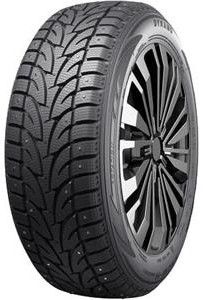
The Latvian winter, with its frequent swings between frost and thaw, produces exactly the wet ice that a Nordic tyre is made for. The Alpine version suits a driver who spends the winter on clear motorways and regularly travels to Lithuania, Poland or Germany; the catalogue has, for example, the Michelin Pilot Alpin 5 and the Pirelli Scorpion Winter. On the Nordic side there are the Continental VikingContact 8 and the studded Nokian Hakkapeliitta 10. Since 1 May 2021 a studless winter tyre may carry an ice grip pictogram next to the snow grip symbol on the EU tyre label, and it is awarded only to soft-compound Nordic tyres, which is why Nokian advises drivers in Northern Europe to look for both markings. The other sidewall markings are explained on the tyre markings page.
How to choose: budget, mid-range and premium
Cheap winter tyres do not come unstuck on snow. They come unstuck on wet asphalt, and that is exactly where the Latvian winter spends most of its time. In the ADAC 2025 test of 31 tyres in size 225/40 R18, fifteen were not recommended and eleven were rated inadequate, almost all of them budget models. At the point where the winner, the Goodyear UltraGrip Performance 3, had already come to a stop from 80 km/h, the Syron Everest 2 was still doing more than 45 km/h. In the Auto Bild 2024 test in size 205/55 R16, the first 20 of the 53 tyres were knocked out in wet braking alone, before the snow section. The cheapest end does have its place: a low-mileage city car that never leaves cleared streets in winter. It is not for a fast motorway car.
The mid-range is underrated in Latvia. In the 2025 Tekniikan Maailma and UTAC test the best studless tyre was the Kumho WinterCraft Ice: on ice from 50 km/h it stopped after 33.1 m, only 0.8 m behind the best studded tyre, the Bridgestone Blizzak Spike 3 with 32.3 m. Brand reputation and performance on ice are not the same thing, so a Marshal, Nexen, Maxxis or Nankang model is better judged on a specific test than on the name.
In the premium class you pay for wet grip and durability. The top three places in the Teknikens Värld 2025 overall ranking went to Nordic studless tyres, with the Continental VikingContact 8 in first place. Among studded tyres the catalogue has the Michelin X-Ice North 4 and the Continental IceContact 3, and for mixed city and motorway use the Bridgestone Blizzak 6 and the Continental WinterContact TS870 P. Just how wide the spread is within a single size is shown by the Auto Bild 2025 twelve-tyre test in size 215/55 R17: on snow from 50 km/h the results run from 22.9 m (Hankook Winter i*cept RS3) to 26.2 m, and in the wet from 100 km/h from 43.8 m to 53.5 m. Almost ten metres of difference on one and the same car.
Low rolling resistance is worth nothing without grip. In the Teknikens Värld test the fuel consumption of the whole field fell between 5.726 and 6.012 l/100 km, which is about 5%, or 85.8 litres over 30,000 km. The budget Goodride Z507, with the second-best consumption, finished second from last overall. The saving on fuel is real, but small. The difference in braking distance is not.
When to change tyres
The calendar and the thermometer do not agree. The legal deadline is 1 December, but Continental recommends switching to winter tyres as soon as seasonal temperatures stay below +7 degrees, and CSDD's technical specialists point out that the grip of summer tyres deteriorates noticeably at around 4-6 degrees. In Latvia that usually coincides with the first night frosts in late October or early November.
CSDD urges drivers not to wait for December and points out that on a slippery road the braking distance at 50 km/h can be up to three times longer than on dry asphalt. Overdoing it at the other end is not worth it either. According to Continental's data, using winter tyres in warm weather can shorten their life by as much as 60%; it lengthens the braking distance on dry roads and raises rolling resistance along with fuel consumption. The same applies in spring, and for studs the deadline is strict: 1 May. The timing of the changeover is covered in more detail in the article When to fit winter tyres.
Size, load index and electric cars
The winter tyre range starts at R13 and runs up to about R22 inches, with the occasional size outside those limits; widths go from 135 to 355 mm, and the R16-R18 group is the most densely covered. Take the size from the registration certificate or from the sticker inside the fuel filler flap, not from the old tyres if the car was bought second-hand.
The load index is a floor, not a suggestion: you must not fit one lower than the certificate states, but you may fit a higher one. The speed rating has a documented exception, and Michelin spells it out clearly: on a winter tyre marked 3PMSF it may be lower than on a summer tyre, provided the driver observes the corresponding maximum speed and a reminder sticker is placed in clear view inside the car.
For electric cars and heavy crossovers everything comes down to mass. Continental points out that the weight of the battery puts extra load on the tyres and that checking load capacity is critical on an electric car tyre. The manufacturer advises considering XL construction, and instant torque only speeds up wear. Rolling resistance has a direct effect on an electric car's winter range, and with no engine noise in the cabin the hum of the tyres is more audible. There is no separate category of winter tyre for electric cars. There is only the right size, a sufficient load index and XL where the mass calls for it. SUV and crossover sizes are gathered in the SUV tyre section, electric cars in the electric car tyre section, while minibuses and commercial vehicles need C-class tyres with the appropriate load index.
Storage between seasons and the age of the tyre
The set that comes off should be kept clean and dry, in a cool, dark place, away from sunlight, sources of ozone and solvents. Tyres on rims are stacked or hung on a wall, tyres without rims are stood upright and turned from time to time. It is worth marking each one with the wheel it came from, so that the set can be rotated correctly next season.
Age means as much to a tyre as tread does. ADAC notes that a winter tyre loses part of its winter properties after roughly six years, once the polymer chains oxidise. ADAC advises against using tyres older than eight years, and any passenger car tyre should be replaced after ten years regardless of tread; CSDD mentions 5-6 years in its own recommendation. The week and year of manufacture are shown by the four-digit DOT code on the sidewall: the first two digits are the week, the last two the year, so 1024 means the tenth week of 2024. It is worth checking that on a new tyre in the shop as well.
The figure to work to is 4 mm, not 1.6 mm. TÜV NORD recommends the same 4 mm even where the law asks for less, and CSDD warns that a tyre right on the limit may have only a month of use left. A set that starts at 8-9 mm lasts more seasons than one that starts at 7.