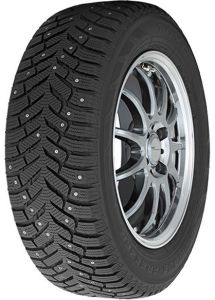
How Toyo positions its winter tyres and the technology behind them
Toyo Tire started out in 1945, and the company is still headquartered in Itami, in Japan's Hyogo Prefecture; besides Toyo, the group's tyre portfolio also includes Nitto and Silverstone. The winter range splits into two families, and the split is technical rather than a marketing one.
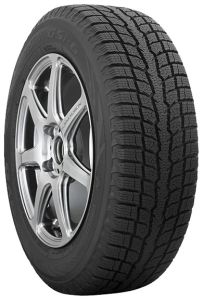
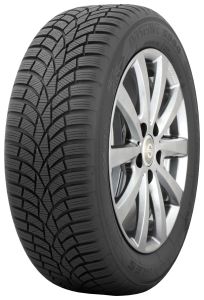
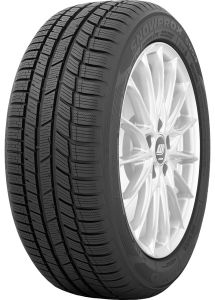
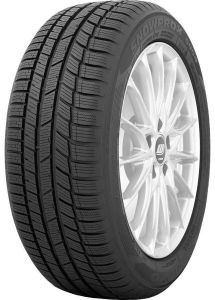
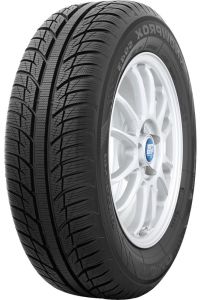
Toyo sorts the Observe family by conditions in its European catalogue. Models intended for the Nordic region have a softer compound and a denser network of sipes that works on ice and packed snow; models built for the Central European winter hold better on wet tarmac and at higher speeds. Nokian describes the same dividing line: Nordic-type studless tyres give noticeably better grip on ice and snow, whereas the Central European versions work better in the wet. The Snowprox family has two models: the S954 for passenger cars and the S954 SUV for SUVs. The S954 has an asymmetric tread pattern, and the manufacturer lists silica in the compound; tarmac is the main surface for both Snowprox tyres, and their speed ratings are higher than on the Observe side. Toyo bases its compound development on Nano Balance Technology, a platform that predicts the properties of the rubber at nano level and allows rolling resistance and wet grip to be tuned separately. In the ice-focused Observe models, crushed walnut shells are added to the compound, their hard particles biting into the surface of the ice.
Tyre Reviews' comparative measurements show how large that difference is in numbers: braking on ice from 25 km/h takes 9.9 m on a studded tyre, 11.06 m on a Nordic studless tyre, 14.15 m on a Central European winter tyre and 15.09 m on an all-season tyre. In the wet from 80 km/h the picture reverses: the Central European winter tyre stops in 26.60 m, while the Nordic studless tyre needs 31.58 m. That is exactly why Toyo's range holds both schools.
The model range by intended use
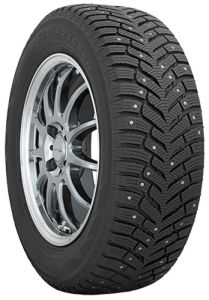
Two questions narrow the range fastest: what the car is and whether studs are needed. The studded part is limited to the Observe G3 Ice and the Observe Ice-Freezer SUV, and the G3 Ice is made both factory-studded and studdable. All the rest are studless tyres.
| Model | Studs | Intended for | Diameters | 3PMSF |
|---|
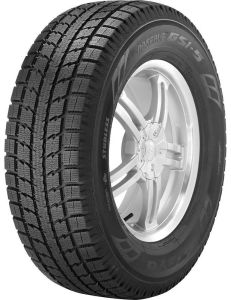
| Observe GSi-6 | Studless | Passenger cars and SUVs, Nordic type | R14-R22 | Yes |
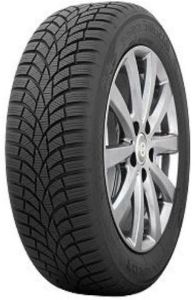
| Observe S944 | Studless | Saloons, estates and lighter SUVs, Central European type | R15-R20 | Yes |
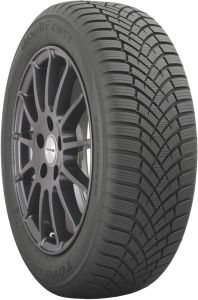
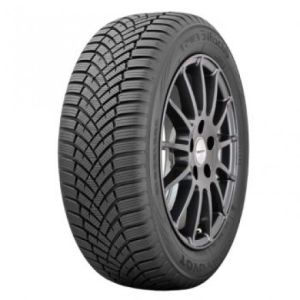
| Observe Winter Sport 1 (EWS1) | Studless | Passenger cars and SUVs, distinctly a tarmac tyre | R15-R20 | Yes |
| Snowprox S954 | Studless | More powerful passenger cars, speed ratings up to W | R16-R21 | Yes |
| Snowprox S954 SUV | Studless | SUVs and crossovers, focus on tarmac | R17-R21 | Yes |
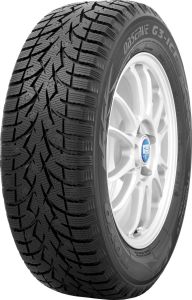
| Observe G3 Ice | Studded and studdable | Passenger cars and SUVs, ice and snow | R13-R22 | Yes |
| Observe Ice-Freezer SUV | Studded | SUVs on icy roads | R16-R22 | Yes |
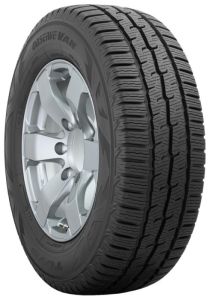
| Observe Van | Studless | Vans and light commercial vehicles, C marking | R14-R17 | Yes |
The diameter column lists the sizes the model currently appears in on our listing; the manufacturer's range may be wider, and availability in a specific width and profile is shown by the size filter. The ends of the range are thin: almost everything is concentrated between R16 and R20, so the choice is narrow for very small and very large rims.
A couple of things do not fit into the table. The XL load index is on most models, so finding a suitable tyre for heavier cars and electric vehicles is not difficult. Rim protection (RP) is a property of a specific size rather than of a model: it appears on several models, but not in all of their sizes. With expensive rims you therefore have to filter by size. RunFlat is not in this range at all. Every tyre in the segment carries the three-peak mountain snowflake (3PMSF) marking, and that is not a formality: it is awarded only after testing under UNECE Regulation No. 117, while M+S is a manufacturer's self-declaration with no mandatory test. CSDD points out that since 1 December 2024 only tyres with that marking may be used during the mandatory winter period.
What the independent tests show
The test history of Toyo's winter models is uneven: one model has plenty of results, another almost none. In ADAC's 2022 test in size 215/60 R16 H, the Observe S944 earned an overall score of 3.1 and a recommended rating: good results on dry, on ice and in wear resistance, but below the test average in the wet and on snow. In a Tyre Reviews summary of ten tests from 2020 to 2023, the same model brakes 16.9 percent shorter on snow than budget rivals, but trails premium tyres by 5.4 percent in the wet. That is where this brand sits.
The tarmac model behaves differently. Auto Bild in 2025 measured the 225/40 R18 size, and there the Observe Winter Sport 1 had the second-shortest braking on dry (42.9 m from 100 km/h) and the third-shortest in the wet (52.0 m), yet finished last of twenty tyres in the snow disciplines. Results are steadier on the SUV side: the Snowprox S954 SUV has averaged 8th place across four tests, while the Snowprox S954 for passenger cars has averaged 16th across nine.
Test World in 2020 placed the Nordic-type GSi-6 HP 18th with weak performance on ice, but in Teknikens Värld in 2025 the same model was already 8th out of the 19 tyres rated. In that same test the studded passenger-car Observe Ice-Freezer was excluded from the ranking because the stud protrusion was 1.53-1.76 mm against the 0.95-0.96 mm stated in the certification; our range carries the SUV version of this model, so the result is worth noting. There is no independent European test of the Observe G3 Ice at all, and the only public result is 11th place out of seventeen tyres in the 2020 Consumer Reports test in North America. It is fairer to say that outright than to fill the gap with the manufacturer's own description.
Who Toyo suits best
In this segment Toyo is a mid-range brand with a publicly verifiable test history. If the car mostly runs on gritted tarmac, the studless Observe GSi-6 or S944 copes with that without surprises; for a more powerful car with a higher speed rating the Snowprox family is the more logical choice. Vans and light commercial vehicles have a line of their own, the Observe Van with the C marking and a reinforced casing. There is no separate line for electric vehicles, and that is not a shortcoming: the choice is set by the load index and speed rating the car manufacturer requires, and XL versions are plentiful in the range.
There are cases where another brand in our range is the better fit. A car that comes from the factory on RunFlat tyres will find no equivalent in Toyo's winter range. If studs are essential, start by checking availability in your own size, because only two models are studded and in some sizes there simply are none. For anyone who spends the winter on uncleared roads packed with deep snow, the tarmac-focused Winter Sport 1 will be too weak - Auto Bild's snow result shows that without excuses. For the cheapest possible winter set, look at our budget brand sections: Toyo does not sit on that shelf.