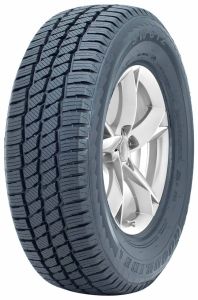
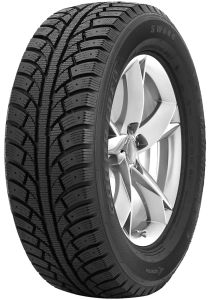
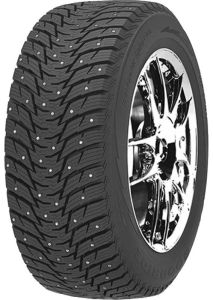
The philosophy and technology behind Goodride winter tyres
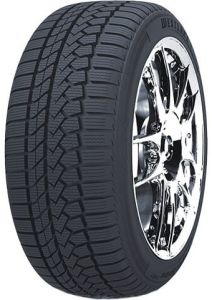
Goodride belongs to Zhongce Rubber Group, or ZC Rubber, a company founded in Hangzhou in 1958. Today it is the largest tyre manufacturer in China, and it also owns Westlake, Chaoyang, Trazano and Arisun. The manufacturer itself states that the group has nine plants in China and Thailand, sells in more than 120 countries and took ninth place on the list of the world's 75 largest tyre makers in 2024. The brand entered the European market in 2019, when the Z series went on sale with the Z-507 winter tyre and the studded Z-506. According to the manufacturer, the Z-507 is built for the Central European winter, where the road is wet more often than snowy, while the Z-506 tread was developed by a Finnish team for the Nordic market.
That scale gives the buyer two things. One is size coverage: a single brand can serve an old hatchback and a delivery van alike, including narrow sizes for older cars. The other is certification, because the manufacturer confirms that all of its winter tyres carry both the M+S and the 3PMSF marking, and that applies to every size in our range. Scale does not buy test wins, though. A count of factories is no substitute for the rubber compound that makes Nordic premium tyres work on ice.
The model range by application
The choice starts with the stud question: only two models have studs, the rest are studless friction tyres.
| Model | Studs | Segment | Available diameters | 3PMSF |
|---|
| Z-507 Zuper Snow | studless (friction) | larger saloons, estates, crossovers | R16-R20 | yes |
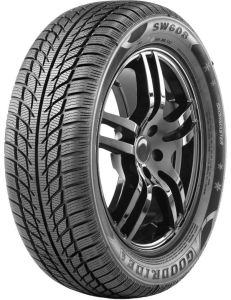
| SW608 | studless (friction) | passenger cars, wide size coverage | R14-R20 | yes |
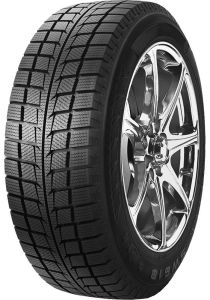
| SW618 | studless (friction) | passenger cars, wider sizes too | R14-R20 | yes |
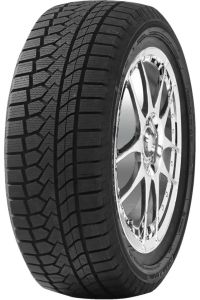
| SW628 | studless (friction) | passenger cars and crossovers on wide sizes | R16-R20 | yes |
| SW612 | studless (friction) | vans and commercial vehicles, C marking | R13-R16 | yes |
| SW606 | studdable, some sizes come ready-studded | passenger cars and van C sizes | R15-R20 | yes |
| Z-506 IceMaster Spike | factory-studded | touring, compact and mid-size cars | R16-R18 | yes |
The tread pattern here is a practical difference, not a cosmetic one. The manufacturer's SW608 page describes a V-shaped directional tread with deep drainage grooves that push water and wet snow out to the sides, and that is exactly what suits the Latvian December slush. The SW618 is directional as well. The Z-507 and SW628 work asymmetrically. In the Z-507 description the manufacturer promises zigzag sipes and a tuned shoulder-groove angle, and for the SW628 - deeper grooves and a silica-enriched compound that stays flexible in the cold.
The speed rating narrows the choice faster than anything else. The SW612 is rated N to T, so it is a van tyre that has no business on a fast passenger car. With H and V, the Z-507 is the fastest model in the range. The letter you need is set by the car manufacturer, not by the retailer.
The XL marking appears on almost every model. A reinforced tyre has a stiffer internal structure and a higher load index and, as Continental explains, at full load it has to be inflated roughly 0.4 bar higher than a standard tyre. If the car left the factory on XL tyres, a standard tyre is not a valid replacement.
The letter C on the SW612 means a commercial-vehicle construction. The manufacturer positions it for vans and delivery vehicles: three zigzag grooves and reinforced sidewalls. On a passenger car this tyre will be harder and noisier than it needs to be. Rim protection (RP) is only on a few Z-507, SW608 and SW628 sizes in the range, so for a low profile on large rims it is worth checking on the size card first. There are no RunFlat sizes here at all. The SW628 also gets misread in the workshop: wide R20 sizes do not make it an SUV tyre, and Goodride classifies it under Passenger Cars. For a heavy off-roader, therefore, the first step is to compare the load index of that particular size with what the vehicle requires.
You read your own size off the tyre sidewall, the sticker in the driver's door frame, the owner's manual and often the fuel filler cap as well. The vehicle registration certificate carries no tyre size, load index or speed rating, so there is no point looking there.
What the independent tests show
Test results for the factory-studded Z-506 IceMaster Spike are public, and there is no sense in glossing over them. The aggregate score on Tyre Reviews is 6.6 out of 10 from two professional tests with an average eighth place: dry 68.8, snow 67.6, ice 61.2 and wet 48.3 points out of 100. On ice it stops 17.3 per cent further on than premium rivals. In the Vi Bilägare 2023 studded tyre test in size 225/45 R17 the Z-506 came seventh out of eight tyres, with the best snow braking in the group at 12.8 m and the worst ice handling time at 44.1 s. The testers put the weak ice performance down to the hard rubber compound and the stiff construction.
On the studless side the picture is just as uneven. In ADAC's 2021 test the Z-507 in size 225/50 R17 was given an overall score of 5.5, or mangelhaft, the lowest on the ADAC scale. In aggregated test data the SW608 brakes on a wet surface over a distance 14.6 per cent longer than premium tyres, while on a dry surface the gap is only 2.7 per cent, so in everyday dry driving you will not notice it. For the SW618, SW628 and SW606 there are no published independent tests at all, so in fairness they can only be judged on their construction and the manufacturer's data.
There are figures where the range does stand up well: rolling resistance and wear. In ADAC's 2025 test the SW608's strengths were low wear and low fuel consumption, with a projected tyre life of 48,400 km. On the van side, in the 2019 ADAC test the SW612 scored the best fuel consumption in the test. The Z-507 did much the same: in Teknikens Värld's 2025 test on a Volvo V60 it had the fourth-best fuel consumption of twenty tyres and an aquaplaning result of 67.2 km/h.
Which drivers Goodride suits in Latvian conditions
For most of the winter what is under the wheels here is salted, wet asphalt rather than clean ice. For a daily run along gritted streets and regional highways the logical set is the SW608 or SW618: a directional tread, plenty of sizes and no date restrictions in spring. A larger saloon or a crossover on a wider factory size is better served by the Z-507 with an H or V rating, while for wide R19 and R20 sizes on large rims the SW628 is what remains. For a van or delivery vehicle up to 3.5 t the choice narrows to the SW612 with its C marking. Studs in the range come from the Z-506 and the SW606, except that studdable SW606 sizes leave the factory without studs and the workshop fits them separately, in all four tyres at once. The CSDD points out that studs are only allowed on public roads from 1 October to 1 May.
If the main criterion is grip on clean ice, the stronger choice is in the Nokian and Sailun sections, where studded tyres also come in larger diameters than the Z-506. These tyres suit an electric car just as they suit any other, only the load index has to cover the higher gross weight, and if the car came from the factory on HL load tyres, an XL tyre is not enough to replace them. For the winter period the CSDD requires at least 4 mm of tread depth on both passenger cars and lorries up to 3.5 t, and only tyres with the mountain-and-snowflake marking have been valid since the 2024/2025 season. For everyday driving Goodride gives you a road-legal winter set in the size the car actually needs.