When to fit summer tyres in Latvia
The law sets the dates, but the changeover day itself is better chosen by the thermometer. Clause 219 of the Road Traffic Regulations requires passenger cars and buses with a gross vehicle weight of up to 3.5 t to have tyres designed for winter conditions from 1 December to 1 March, and since 1 October 2024 these tyres must carry the 3PMSF marking (Cabinet Regulation No. 295). Outside this period summer tyres are legal, so they can go on as early as 2 March. There is no point in rushing, though: it is better to wait until the air temperature stays above +5 to +7 °C for a sustained period, because March still tends to bring night frosts. For studded tyres the same regulations set a firm deadline: driving on them is banned from 1 May to 1 October, so studded tyres have to come off by the end of April even if the weather is still cool. Our article on when to fit summer tyres explains how to choose the changeover day and what to check before fitting.
Summer, all-season or winter tyres for summer driving
Every spring a customer asks us whether winter tyres can simply be used up over the summer. They can, but you pay for it in braking distance. In ADAC measurements, winter tyres braking from 100 km/h on dry tarmac stopped up to 16 m later than summer tyres in the worst case, and even winter tyres worn down to 4 mm needed about 5 m more. At the point where the car on summer tyres had already come to a halt, the other was still doing about 37 km/h. In the wet the winter tyres' results were acceptable, so it is on dry, warm roads that you lose the most.
An all-season tyre is a compromise. Its rubber has to work from roughly -30 to +40 °C, and in summer you can feel it. In Auto Bild's 2026 all-season test (225/45 R17), the summer tyre included for comparison had a braking distance on dry tarmac about 2 m shorter than any of the all-season tyres, and it was the best in both aquaplaning tests. In wet braking the best all-season tyre trailed it by only about 1 m. On snow the picture was reversed: the summer tyre needed almost twice the distance.
| Criterion | Summer tyre | All-season tyre | Winter tyre in summer |
|---|
| Braking on dry tarmac | Shortest distance | About 2 m longer than the summer tyre (Auto Bild 2026) | Up to 16 m longer from 100 km/h, about 5 m with tyres worn down to 4 mm (ADAC) |
| Braking on wet tarmac | Shorter distance than all-season tyres | The best one trails by about 1 m | Acceptable results |
| Aquaplaning | Best both in a straight line and in a bend | Trails the summer tyre in both tests | Not compared in these tests |
| Rubber and wear in the heat | Rubber stays firm in the heat | Compromise compound for a range of -30 to +40 °C | Above +7 °C the rubber turns soft and performs worse, and the tread wears faster |
| Noise and rolling resistance | Quieter and with lower rolling resistance than a winter tyre | Depends on the model - compare the EU label | Louder, with higher rolling resistance |
A summer tyre resists aquaplaning better because its tread has several wide longitudinal grooves and large, stiff blocks with few sipes. The other factor is tread depth: in an ADAC test a new tyre started to aquaplane at 87 km/h, but one worn down to 4 mm did so at just 63 km/h. In deep water, though, the only thing that helps is a lower speed.
Choosing the size, load index and speed rating
On the tyre's sidewall the size looks something like this: 225/45 R17 94W. The first three numbers are the width in millimetres, the profile height as a percentage of the width, and the rim diameter in inches. They are followed by the load index and the speed rating letter. None of these may be lower than what the manufacturer specifies for your car. You will find the correct figures on the sidewall of your current tyres, on the sticker in the driver's door frame, in the owner's manual or on the inside of the fuel filler cap.
A tyre marked XL has a reinforced construction and a higher load capacity in the same size. If the manufacturer's specification says XL, choose XL. More than half of our summer models are available in an XL version, and you can recognise the C-class sizes intended for vans by the letter C after the diameter.
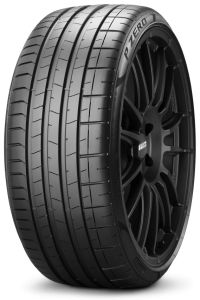
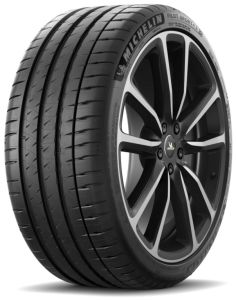
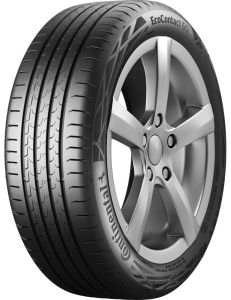
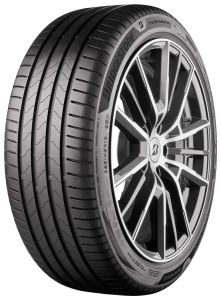
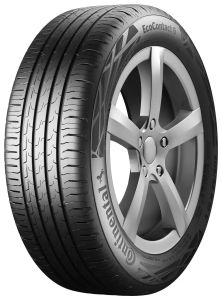
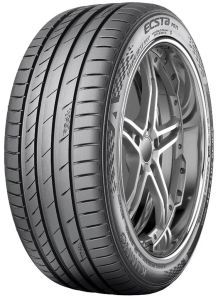
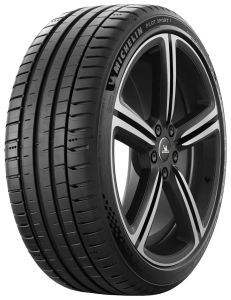
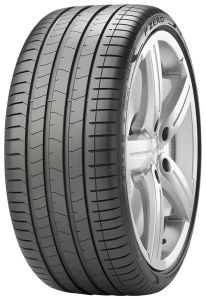
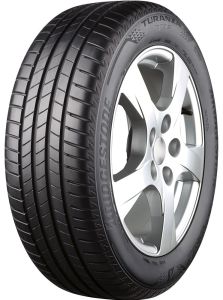
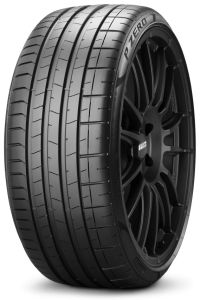
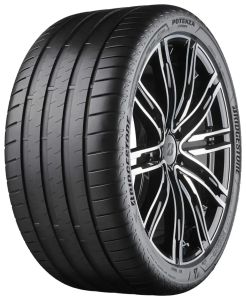
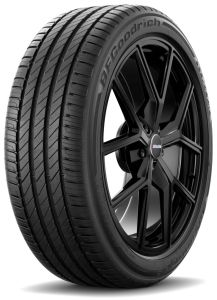
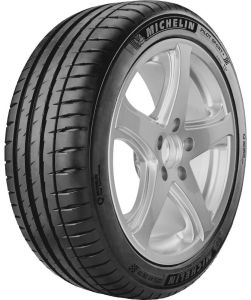
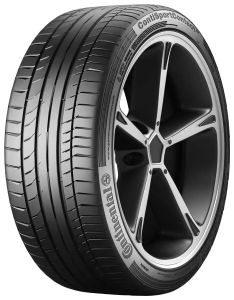
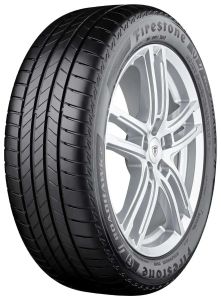
Summer tyres also differ in character. Comfort or touring models, such as the Bridgestone Turanza 6, run more quietly and last longer. UHP models such as the Michelin Pilot Sport 4 S or Pirelli P Zero brake and steer more sharply, usually with a higher speed rating, but the ride is firmer and the tread wears faster. Low rolling resistance tyres such as the Continental EcoContact 6 save fuel or extend an electric car's range on a single charge. If you cover most of your kilometres on the motorway with the family, we usually recommend the first group.
On the product page you will also see the EU tyre label under Regulation (EU) 2020/740. It shows the wet grip class (A-E), the rolling resistance class (A-E) and external noise in decibels with its class (A-C), plus a QR code linking to the EPREL database. One wet grip class can mean a stopping distance 3-6 m longer, while one rolling resistance class amounts to about 80 litres of fuel over the tyre's life. On the noise scale, 3 dB more means a tyre twice as loud. The label only shows three things, though, and it is not enough on its own to choose a tyre.
Large R18-R22 rims and SUVs
With a large rim there is plenty of choice: our summer range has almost as many R18-R20 sizes as R15-R17. A low-profile tyre makes the steering sharper, but its sidewall is lower and absorbs pothole impacts less well. The ride becomes firmer, and on a rough street it is easier to damage both the rim and the tyre's sidewall. After winter there is no shortage of potholes on Latvian roads, so we recommend that owners of large rims tick Rim protection (RP) in the filter: the tyre's sidewall has a raised rubber ridge that protects the edge of the rim when you pull up to a kerb. If the car came from the factory with RunFlat tyres and has no spare wheel, choose RunFlat again as the replacement; you will find summer models of this type in the RunFlat tyres section.
With a heavy SUV, check the load index first. In many of the larger sizes the manufacturer's specification calls for XL, and a tyre with a lower index will not be the right choice even if the size matches. On top of that, in summer the car is often more heavily loaded than at other times of year: holiday luggage, a roof box, a boat or a caravan in tow. So the load index is set by the manufacturer's requirement, not by whichever version happens to be in stock. You will find models designed specifically for crossovers and SUVs in the SUV tyres section.
Electric vehicle tyres in summer
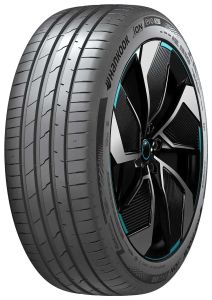
Tyres have a harder life on an electric car. The battery makes the car heavier, and the instant torque wears the tyres out faster. With no engine noise, the tyres' rolling noise is easier to hear in the cabin, while lower rolling resistance gives a longer range on a single charge.
On electric cars the load index requirement is often XL or the newer HL marking. Pirelli says an HL tyre carries about 20% more than a standard tyre and 6-9% more than an XL tyre of the same size. With noise in mind, it is worth looking both at the decibel figure on the label and at tyres with a foam layer inside: according to Continental, ContiSilent reduces certain components of rolling noise in the cabin by up to 9 dB(A), depending on the car, speed and road surface. An ordinary XL summer tyre is also fine for an electric car, provided its load index meets the manufacturer's requirements. The Electric vehicle tyres section has models selected specifically for electric car sizes.
Premium, mid-range and budget tyres: what the tests show
The difference between tyres shows up in the wet. In the ADAC 2026 summer tyre test (225/50 R17, 16 tyres), all the tyres were within 2.8 m of each other in dry braking from 100 km/h. On a wet road from 80 km/h the spread was 7.8 m, from 30.1 to 37.9 m. The Continental PremiumContact 7 won, the Pirelli Cinturato C3 and Goodyear EfficientGrip Performance 2 also earned a "good" rating, while ADAC did not recommend three of the tyres.
The most interesting story is the Linglong Sport Master. It got the best wet score in the whole test, yet it was not recommended, because its projected mileage was about 26,000 km against 57,800 km for the longest-lasting tyre, a Goodyear, and its fuel consumption was higher too. In the ADAC overall rating, safety accounts for 70% and the environment for 30%, and within the safety score the wet road carries a 60% weighting.
In larger sizes the spread is even wider. In the Auto Bild Allrad 2026 SUV test (255/45 R19, nine tyres), wet braking from 100 km/h varied by 9.9 m, dry braking by only 2.1 m, and external noise by 5.9 dB. The results could not be predicted from price alone. Alongside Michelin, Continental, Bridgestone, Pirelli and Goodyear, our range also includes Hankook, Yokohama, Nexen, Maxxis and Nankang, so you can compare at any price level. When advising customers, we recommend looking at independent tests for your size first and only then at the label classes.
Storing winter tyres over the summer
Once the summer set is on, the winter tyres need to be stored so that they are in the same condition in autumn as they were in spring. The manufacturers' advice is simple:
- Clean and dry them. Mark each tyre with the position it came from, for example "FL" for front left, so that it can go back in the right place in autumn.
- Storage space. Cool, dry and dark, away from ozone sources (electric motors, compressors, welding equipment), solvents and fuel.
- Mounted on rims. The wheels can be hung up or stacked, no more than two high.
- Without rims. Store the tyres standing upright, never hung up.
There is more on this in our article How to store tyres properly. Before you put the set away, measure the tread. During the winter period Cabinet Regulation No. 295 requires at least 4 mm on winter tyres, so a worn set can be replaced in good time in autumn with a new one from our winter tyre range.