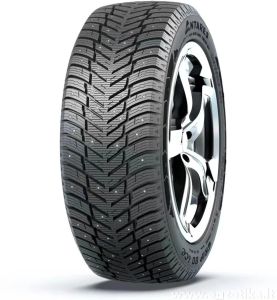
The Antares winter range and its technology
Behind the brand stands the Chinese manufacturer Zhaoqing Junhong Co., Ltd., founded in 2006 in Guangdong province, which builds Maxtrek tyres under the same roof. The company develops and produces semi-steel radial tyres itself and holds ISO 9001 and IATF 16949 quality management systems. For the European market its products are certified to ECE and EEC requirements, and the manufacturer's profile lists more than 500 tyre sizes. This is not a trading label stuck on somebody else's factory tyre.
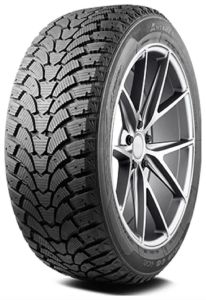
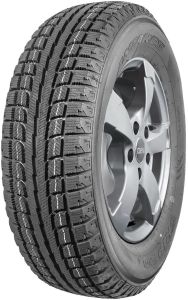
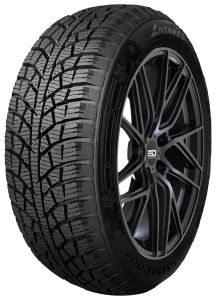
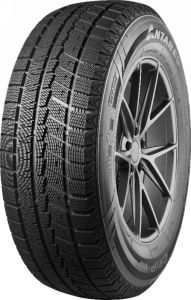
Technology calls for more caution, because only what the manufacturer itself has described in the specifications can be checked. GRIP 60 ICE is a studdable winter tyre with a symmetrical fir-tree pattern, widened lateral grooves and stud holes in the shoulder blocks. The studless friction tyres include Grip 20 with a soft compound, while the Grip WP tread is built in two layers: the softer upper one works for grip, the harder lower one keeps the blocks firm. The claim that the GRIP 60 ICE compound keeps a comparatively low hardness even at -30 degrees, on the other hand, comes from the manufacturer itself, and there are no independent measurements for it.
The model range by intended use
It is worth sorting this range by studs rather than by model name. The studless side is the wider one, one model gives a choice of studs, and one more is stocked in studded form only.
| Model | Studs | Segment | Available diameters | 3PMSF |
|---|
| Grip 20 | Studless (friction) | Hatchbacks, compact class, estates, crossovers | R14-R20 | Yes |
| GRIP 60 ICE | Both versions: ready-studded and studdable without studs | Passenger cars, crossovers, SUVs | R14-R22 | Yes |
| Grip WP | Studless (friction) | Crossovers and larger SUVs | R17-R21 | Yes |
| Lumi 001 | Studless (friction) | Passenger cars and crossovers | R15-R20 | Yes |
| Grip 80 Ice | Studded | Passenger cars | R16 | Yes |
A studded tyre and a studdable tyre are not the same thing, and this is where the misunderstanding most often starts. A factory-studded tyre arrives with the studs already fitted. On a studdable tyre the tread is moulded with the stud holes ready, but the studs themselves are not there, and until a workshop fits them the tyre behaves, in practice and in law, like a studless tyre. The studs are fitted by a workshop, and that is a separate job ordered for the whole set at once, because the CSDD rules do not allow studded and studless tyres to be used on one car at the same time.
Size is not a matter of taste: the car manufacturer sets it. Take the size, load index and speed rating you need from the marking on the tyre sidewall, the sticker in the driver's door frame, the fuel filler cap or the owner's manual; the registration certificate does not carry this data. The speed rating is the letter after the load index: Q stands for 160 km/h, R for 170, S for 180, T for 190, H for 210 and V for 240 km/h, as Continental explains. This range is mostly T and H, because it is a winter segment rather than a sports one, and on some cars an individual Q product will fall below what the manufacturer requires.
An XL or reinforced tyre is a version with a stronger casing and a higher load index. Continental's technical description notes that under full load it needs roughly 0.4 bar more pressure than a standard tyre. For a heavy crossover, a permanently loaded car and an electric vehicle, XL is more often a requirement than a choice. The Antares winter range does have XL sizes, and C-class sizes for vans as well, and next to the metric widths from 155 to 295 mm there are a few inch-type off-road sizes such as 31x10.5 R15. There is no RunFlat in this segment.
What can and cannot be known about performance
There are few independent tests of Antares winter tyres, and there is no reason to dress up the ones that exist. In the 2023 studless and studded tyre test the GRIP 60 ICE in 205/55 R16 finished 7th of 8 overall, yet it was first for traction on ice and third for ice braking; in dry braking and wet handling it came last. In the Auto Bild 2018 comparison the Grip 20 in 195/65 R15 stopped from 80 km/h on a wet surface in 49.8 m, while the winner, the Continental WinterContact TS 860, needed only 34.5 m in the same test; the Grip 20 was knocked out at the wet braking qualifying stage there and finished last. For Grip WP, Lumi 001 and Grip 80 Ice there is no professional test at all. That is neither good nor bad: there simply are no measurements.
When there is no test, four things are left to go on. 3PMSF is a verified fact, because the symbol may only be put on a tyre that has passed the UN Regulation No. 117 snow grip test, and in this range every product carries the marking. Next comes the EU tyre label, which for each specific product shows the fuel efficiency and wet grip class and the exterior noise in decibels; these are exactly the figures that can be compared between two products. The third thing is the construction: studdable or not, XL or standard, how deep the tread is when new. The fourth is simple - whether the size you need is available at all.
Two figures can be compared right now. In the manufacturer's specification the tread on a new GRIP 60 ICE is 9.8 mm deep, and on the Grip 20 it is 8.1-8.5 mm for most sizes; a deeper tread on the studdable model makes sense, because a stud needs material to hold on to. In the Tyre Reviews database the most common label values for the Grip 20 are C for fuel efficiency, D for wet grip and 72 dB for noise, but they vary from size to size.
Which drivers Antares suits in Latvian conditions
For the city and motorway driver who in winter mostly gets around on gritted roads, the logical choice is the Grip 20 with the widest size range: it covers small hatchbacks on R14 and R15 rims as well as estates and crossovers. On salt and wet asphalt studs lengthen the braking distance and add noise. If everyday driving means untreated country roads and ice, look at the GRIP 60 ICE, because it is the only one that offers a choice of studs. Larger crossovers and SUVs on wide rims are served by the Grip WP, while the Lumi 001 fills the same niche.
The seasonal dates are the same for everyone. The CSDD states that winter tyres are mandatory from 1 December to 1 March and that studs may be used from 1 October to 1 May. For a passenger car in the winter period the required minimum tread is 4 mm, not the 1.6 mm that applies in summer.
If your winter is mostly ice and you want a tyre whose braking distance can be compared against independent test figures, our catalogue has those in the Nokian winter tyres and Sailun winter tyres sections. Antares is strong somewhere else: the option of studs across an unusually wide diameter range from R14 to R22, while the studless side starts with narrow R14 sizes for a small hatchback and ends with wide R21 sizes for a large SUV. At this level such a wide choice of studs is rare.