The sidewall says Kormoran, but the brand belongs to Michelin: the tyres come from the Olsztyn plant in Poland, which the group has owned since the nineties. This range promises no records, and the EU label shows it - wet grip on these models is rated C or C-D. Buyers who choose this range are usually after the same thing: a proper, certified winter tyre without the premium-brand mark-up. It covers factory-studded models for passenger cars and crossovers, studless tyres for estates and SUVs, and a separate C-marked line for vans. Sizes reach R20 for large crossovers, while older compact cars are covered down to R14. There is not a single all-season tyre in our Kormoran range, so this is a purely winter choice, and none of these models is meant for summer. Every tyre in this range carries the 3PMSF marking, so they all meet Latvia's winter-period requirements. All available models and sizes are listed below.
Kormoran winter tyres
Budget-class winter tyres from the Michelin group: studded and studless, from passenger cars to vans, all carrying the 3PMSF marking.
8 tyre models available


How to choose Kormoran winter tyres
The thinking and technology behind Kormoran winter tyres
The Kormoran name first appeared in 1994 on passenger car tyres from the Stomil plant in Olsztyn, Poland. Michelin gained control of the plant in 1995, and full control in 2005, when the company was renamed Michelin Polska S.A. Even today the official Kormoran website is published by Manufacture Française des Pneumatiques Michelin, so the link to the group is not a marketing story.
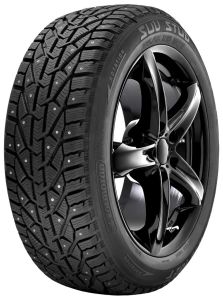
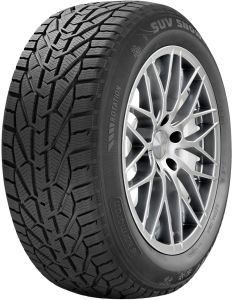
Two things follow from that for the buyer. First: the development work and the quality requirements come from a major manufacturer, not from an anonymous factory. Second: the range deliberately does not compete with the top of the Michelin line-up, and the EU label already shows it - fuel efficiency on these winter models is C or D, and wet grip C or C-D. There are no flashy technology names here. The manufacturer describes the SUV Snow with a high sipe density and a silica compound, the Snow with a V-shaped directional tread, and the STUD2 with factory-fitted studs and their layout across the tread (Kormoran product pages).
The model range by application
The biggest split in the range is studs, so that is where the choice starts. A stud is a hard metal tip that bites mechanically into ice and creates grip where rubber no longer holds the road. A studless tyre works in a completely different way. Its compound stays flexible in the cold, and hundreds of fine cuts in the tread blocks form biting edges that key into snow. On ice the studs win, but on clear and wet tarmac a studless tyre is quieter and calmer, and it is not tied to a season.
| Model | Studs | Segment | Available diameters | 3PMSF |
|---|---|---|---|---|
| Kormoran SUV Snow | Studless | Crossovers and SUVs | R16-R20 | Yes |
| Kormoran SUV Stud | Factory studded | Crossovers and SUVs | R16-R20 | Yes |
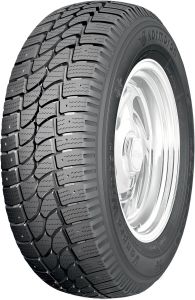
| Kormoran Vanpro Winter | Studless, some sizes studdable | Commercial vehicles, vans and minibuses, C marking | R15-R16 | Yes |
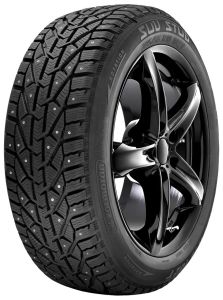
| Kormoran STUD2 | Factory studded | Passenger cars | R15-R17 | Yes |
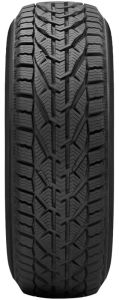
| Kormoran Snow | Studless | Passenger cars and estates | R15-R18 | Yes |
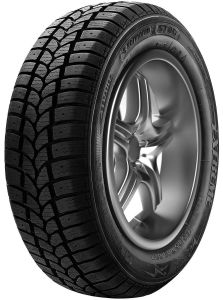
| Kormoran Extreme STUD | Factory studded | Passenger cars with smaller wheels | R14-R17 | Yes |
In practice it looks like this. The SUV Snow and the SUV Stud are the only models in the range that go up to R20, and almost all of their sizes carry the XL marking; a heavier body needs the higher load index. The names mislead some buyers here: the SUV Snow is a studless tyre, while the studded version for a crossover or an SUV is the SUV Stud. The classic passenger car and estate tyre is the Snow, from the compact class to the mid-size class. The Vanpro Winter, in turn, is not simply a larger passenger car tyre: the C marking means a reinforced casing and a higher operating pressure, and the sidewall carries two load indexes, the first for single fitment, the second for twin fitment. Some Vanpro Winter sizes are studdable, that is, prepared for studs to be fitted, but they leave the factory without them. A studdable tyre is not a studded tyre.
The factory-studded models are the STUD2, the Extreme STUD and the SUV Stud, all with a T speed rating, and the Extreme STUD is the only way to put a Kormoran winter tyre on R14 wheels. Across the range the bulk of the sizes sits around R16 and R17. The speed ratings here are R (170 km/h), T (190 km/h), H (210 km/h) and V (240 km/h), so for a more powerful car it is the letter on the sidewall that matters, not the model name. On a winter tyre with the 3PMSF marking a lower speed rating is acceptable as long as the driver does not exceed that speed; Michelin puts it the same way. Nobody grants that kind of allowance for load: the load index must never be lower than the car manufacturer requires.
Independent tests and what to expect from the budget class
For the studded half of the range there are no independent measurements. Budget winter tyres are tested by ADAC, Auto Bild and Tyre Reviews, but the STUD2 has not made it into those tables: Tyre Reviews states outright that the model has not been in a single test. The choice here rests on the EU label and the manufacturer's specification, not on a test record. It is more honest to say so plainly than to talk around it.
The Snow, though, has been measured. In Auto Bild's 2024 winter tyre test, in size 205/55 R16, its wet braking distance was 41.5 m, which put it 39th; the best result in the test was 34.6 m and the weakest 50.6 m. That is a typical budget-class result, and wet tarmac is exactly where the gap to the top of the market shows up first. How large that gap can be is shown by the same magazine's 2025 winter test in size 225/40 R18: between the best tyre (50.9 m) and a cheap budget tyre (70.5 m) there was a 19.6 m difference in wet braking from 100 km/h. Kormoran did not take part in that test, so the figure describes the segment, not a specific model.
The two halves of the range behave differently on the road, and the difference has been measured. In the Tyre Reviews comparison of tyre types, braking distance on ice from 25 km/h was 9.9 m for studded tyres and 11.06 m for Nordic studless tyres, while the measured noise was 70.1 dB and 66.2 dB. On wet surfaces the order reverses. What decides it is which surface dominates a particular route: ice or wet tarmac.
Which drivers Kormoran suits in Latvian conditions
If most winter kilometres are covered on maintained city roads and motorways, the logical choice is a studless tyre: the Snow for a passenger car, the SUV Snow for a crossover or an SUV. For a courier or a small fleet, where the vehicle works under load through the winter, there is the Vanpro Winter; there it is load capacity that matters, not top speed. Studs make sense for anyone who regularly ends up on ice: unmaintained rural roads and the dark morning and evening hours outside town. For a passenger car the choice is then the STUD2, or the Extreme STUD for R14 wheels, while a crossover or an SUV takes the SUV Stud in sizes up to R20. A studded set is bought for all four wheels at once.
Studs in our Kormoran range are not limited to passenger cars. For a passenger car they are the STUD2 and the Extreme STUD, which together cover R14 to R17, while a crossover or an SUV takes the SUV Stud, from R16 to R20.
The whole range meets the winter-period requirements. CSDD states that since 1 December 2024 only tyres bearing the mountain and snowflake symbol may be used in winter. Winter tyres are mandatory from 1 December to 1 March, and the minimum tread depth for a passenger car is 4 mm. Studs are allowed from 1 October to 1 May, and they must not be mixed with studless tyres on the same car.
Frequently asked questions
Special tyre categories
Niche tyre segments for specific applications - from all-terrain and sports tyres to seasonal and technology-focused tyres.
What our customers say
Happy customers are our best advertisement.


Pasūtijumu saņēmu ātri - par riepām pastāstīt nevaru jo neesmu uzlicis, bet izskatās labi.
Super
Viss process un piegāde ir ļoti ātra.
Labākais riepu veikals, skaidri norādīti riepu parametri, apzīmējumi, ražošanas gads, milzīgs sortiments. Iepērkos jau 3. reizi. Noteikti iesaku. Var atrast ļoti labus akcijas piedāvājumus riepām ar pāris gadu vecāku ražošanas datumu. Ja saņemsiet riepas uz vietas bez piegādes, tad sagatavojiet skaidru naudu, jo nav karšu terminālis.
Man bija nepieciešams daudzpusīgs MICHELIN riepu komplekts. Ne visi pārdevēji Rīgā varēja to piedāvāt. "Rigas Repas" piedāvāja viszemāko cenu. Piegāde bija iespējama nākamajā dienā. Es saņēmu oriģinālu MICHELIN ziemas riepu komplektu par vislabāko cenu Rīgā. Es ļoti iesaku šo pārdevēju.
Super!
Отличный магазин покрышек, быстро , четко и по существу.
Bija labi,riepas " Greenland" kvalitāte apmierina!
Perfekti! Cena, piegāde 😎👍