
Continental for a Latvian winter: how WinterContact, VikingContact and IceContact differ
TS870 and TS870 P are not two generations
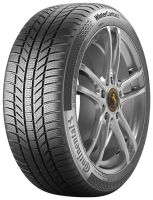
Continental released both WinterContact TS870 versions on the same day, 3 May 2021. They are not an older and a newer generation. The TS870 tread is V-shaped, with main grooves that flow into a wavy centre groove; sizes start at 14 inches and the speed runs up to 240 km/h. The TS870 P tread does not use the V shape. It has a stiffer construction with four wide longitudinal grooves between the block rows, and it is intended for larger rims and speeds up to 270 km/h.
Both versions have the improved Cool Chili compound and Hydro Grooves. The interlocking 3D sipes and the SnowCurve+ groove wall structure appear in the manufacturer's description only for the TS870, and there it is also compared with the previous TS 860: a 3% shorter braking distance on ice, 5% better handling in snow, 10% more mileage. Continental measures the TS870 P against the TS850 P and states a 4% shorter braking distance in the wet and 16% more mileage (Continental, 2021). The choice is therefore decided by the car and the rim size, not by which one is newer.
VikingContact for ice, WinterContact for tarmac, EcoContact for summer
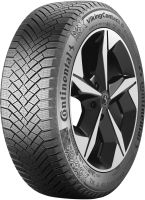
Continental divides non-studded winter tyres into two families. WinterContact is a Central European type tyre for wet tarmac, slush and higher speeds, VikingContact - a Nordic type non-studded tyre for ice and packed snow. The VikingContact 8, announced in February 2024, has three-layer sipes in the shoulder blocks - a straight, a zigzag and a wavy section one behind another - and a new soft compound for low temperatures; in the EU label it receives class A for exterior noise (Continental, 2024).
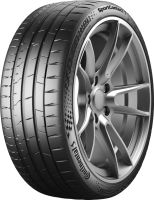
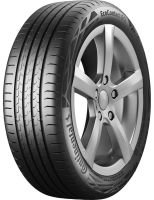
Studs are in the IceContact series: the IceContact 3 and the IceContact 8 announced on 19 January 2026, which has two different stud types and a chemical bond between the stud and the rubber (Continental, 2026). For summer there are the PremiumContact 6 and 7 for comfort, the EcoContact 6 and 7 for economy, the SportContact 6 and 7 for powerful cars, and for all seasons the AllSeasonContact 2. In our range Continental tyres run from R13 to R24.
ContiSeal, ContiSilent and SSR are markings for specific sizes, not separate lines, just like the OE markings MO, AO or N0 - their meaning is explained on the tyre markings page. There is no separate electric vehicle series in our Continental range: the EV compatible marking means the tyre suits an electric car, a car with a combustion engine and a hybrid alike, and most of the newer models carry it. They can all be viewed together in the electric vehicle tyres section.
| Model | Season | Studs | Diameters |
|---|---|---|---|
| WinterContact TS870 P | winter | non-studded | R15-R23 |
| WinterContact TS860 S | winter | non-studded | R16-R23 |
| AllSeasonContact 2 | all-season | - | R15-R22 |
| PremiumContact 6 | summer | - | R15-R22 |
| EcoContact 6 | summer | - | R13-R22 |
| SportContact 5 | summer | - | R17-R22 |
| SportContact 7 | summer | - | R18-R24 |
| EcoContact 6 Q | summer | - | R16-R23 |
| VikingContact 8 | winter | non-studded | R15-R22 |
| SportContact 6 | summer | - | R18-R24 |
What the Finnish, Swedish and German testers measured
In the 14-tyre test run by the Finnish magazine Tekniikan Maailma and UTAC (205/55 R16 on a VW Golf) the VikingContact 8 was first among the Nordic type non-studded tyres: in snow it braked in 49.6 m from 80 km/h, when the best result in the test was 49.5 m, and on ice in 47.1 m from 50 km/h against the best 32.3 m. The IceContact 3 was second among the studded tyres in the same test, and on wet tarmac it braked in 35.5 m - the second best result in that group. For noise it received 6 points, while the best tyre in the test received 10 (Tekniikan Maailma 2025).
In the 20-tyre test by the Swedish magazine Teknikens Värld (235/45 R18 on a Volvo V60) the VikingContact 8 won overall with a full 20 points for handling in snow and the lowest fuel consumption in the test, 5.726 l/100 km. In the wet it had 6 points out of 10, and aquaplaning began already at 56.7 km/h. The WinterContact TS870 P received 6 out of 20 points on ice there, but 8 out of 10 in the wet, and aquaplaning began at 76.6 km/h (Teknikens Värld 2025).
In Germany the TS870 won the Auto Bild 2024 test in size 205/55 R16 with a rating of 1.2 (sehr gut). The only downside named in both German tests was the price. A year later the TS870 P shared third place in size 215/55 R17 with a rating of 1.3 and braked in snow in 23.4 m from 50 km/h.
Who Continental suits best
For a Latvian winter Continental gives three different answers. If the car spends most of the winter on cleared tarmac and motorways, the WinterContact TS870 or TS870 P fits - both have earned high ratings in German winter tyre tests. Frequent ice and packed snow on the route mean the VikingContact 8, and with studs - the IceContact 3 or the newer IceContact 8.
Studded tyres may be used in Latvia from 1 October to 1 May, and in winter the M+S marking alone is no longer enough: all WinterContact, VikingContact, IceContact and AllSeasonContact 2 tyres in our range have the 3PMSF marking. On changing tyres in good time there is a separate article. For summer the choice starts with the PremiumContact and EcoContact families, and the sports tyre of the current generation is the SportContact 7.