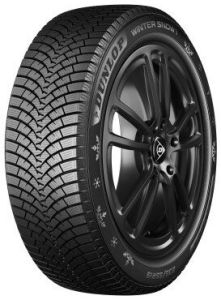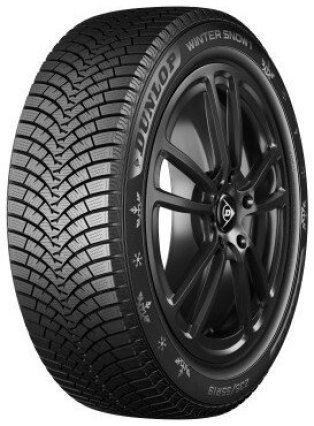

At traffic lights, snow packed down by passing cars quickly turns as smooth as ice, and that is where it becomes clear whether the car will pull up before the stop line. At that moment the Dunlop Winter Snow1 is at its strongest. In Teknikens Värld's 2026 winter test, which covered 18 tyres in size 235/45 R18, it received the maximum score for braking on snow, and on ice it braked just as well as the strongest of its studless rivals.
The overall standings paint a different picture. Of the five Nordic-type studless tyres, the Winter Snow1 came fifth, and the magazine named it the weakest in its group. The winner was the Continental VikingContact 8, and the group also included the Goodyear UltraGrip Ice 3, Pirelli Ice Friction and Nokian Hakkapeliitta R5. The biggest shortcoming showed up on wet tarmac: the steering responded slowly and imprecisely, the front of the car slid wide in bends, and puddles in corners knocked it off its line. In wet handling the tyre scored 4 points out of 10, against 6 each for the other four. In ice and snow handling, too (7 and 8 out of 10), it ended up at the back of the group.
Not every measurement went against it. In the straight-line aquaplaning test it lost grip at 59.1 km/h, later than the VikingContact 8 (54.9 km/h) and the Hakkapeliitta R5 (54.1 km/h), although the best result was 60.8 km/h. It does cost more in fuel, though: at a steady 70 km/h the car used 6.12 l/100 km, 0.35 litres more than on the Goodyear UltraGrip Ice 3, which is in line with class D for fuel efficiency on the EU label. The test did not measure wear.
Sumitomo's hand is evident in the construction. In 2025 Sumitomo Rubber Industries took over the rights to the Dunlop brand in Europe from Goodyear, and the Winter Snow1 is part of the first line-up of models under the new owner. The technology names, 4D-Nano Design and Miura-Ori, are also Sumitomo group terms. The manufacturer does not name a predecessor. The tread is multi-directional, with many blocks. As Dunlop emphasises, the dense Miura-Ori 3D sipes run in several directions and help hold grip on ice, yet the blocks remain stiff. The V-shaped Cross-Point grooves, the manufacturer says, clear compacted snow from the groove edges. A third detail, double ice edges, is mentioned by Dunlop but not explained. According to the manufacturer, the Ultra-Grip Compound (4D-Nano Design) is rich in silica and plasticisers so that the rubber stays soft even in a Nordic frost. Teknikens Värld measured the test tyre's new tread depth at 8.2 mm and its weight at 11.6 kg. Some sizes have rim protection (RP); the product page shows whether a particular size has it.
In Dunlop's winter range the Winter Snow1 is the only studless tyre with the ice grip symbol, and alongside it sits the studded SP Winter Ice03. The Winter Snow1 is intended for passenger cars and SUVs, carries the 3PMSF and M+S markings, and suits an electric vehicle or a hybrid just as well as any other passenger car. According to the manufacturer's data, all sizes are XL with a T speed rating, the wet grip class is D and external noise is 71 dB (class B). The test figures outline a clear profile: the tyre is most at home on snow and ice, but those who mostly drive on wet city tarmac in winter should keep the wet handling score in mind. The tyre has been on the EU market since June 2026. At the Rīgas Riepas shop the Dunlop Winter Snow1 is available in 18 sizes with wheel diameter from R16 to R19 inches.