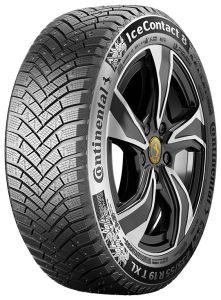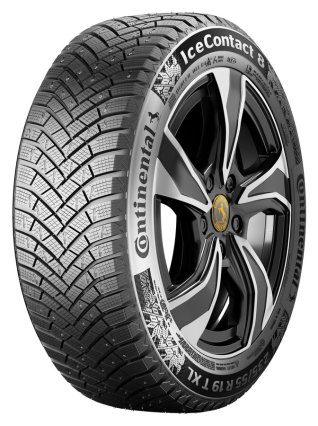

Second place out of seven tyres and 8.5 points - that is Continental's result in the Tekniikan Maailma studded tyre test in size 205/55 R16, with only the Nokian Hakkapeliitta 10 ahead on 8.7. The result, though, belongs to the previous generation, the IceContact 3, since the test was run when the new tyre was not yet on the market. And it is the new one that Continental showed in Hanover on 19 January 2026: the IceContact 8, the latest generation in the series.
The size range at launch runs from 15 to 22 inches, so from compact cars to heavier SUVs and hybrids. A studded winter tyre suits an electric car just as well as one with a combustion engine, and Continental singles out electric cars among the target audience. The only difference is that the greater weight and the instant torque demand more from the studs. That is why retention is the main story this time.
Stud retention over the tyre changeover season is the first thing you notice: in spring it is immediately obvious which tyre has lost half its studs. Between the stud and the rubber Continental has created a chemical bond, which the company's Norwegian division calls Stud Anchoring Technology, so no gap is left around the stud for dirt and sand to collect in. The Swedish announcement also puts a figure on it: the bond is said to be four times stronger than on studded tyres without an equivalent solution, although there is no independent confirmation of that so far. The second novelty is the twin studded concept - two different stud types in a single tread. One bites into the surface under acceleration and braking, the other takes care of lateral grip and stability in corners.
The tread pattern is directional and V-shaped, with larger and deeper blocks. The more stable the base under a stud, the less the stud moves and the less often it falls out. The manufacturer links this to higher overall mileage, but does not quote a figure in kilometres. The sipe layout is carried over from the studless Continental VikingContact 8. According to the manufacturer it won nine major Nordic tests in 2025, but those are another model's achievements. The compound combines a system of softening agents with a new flexible polymer developed for this model, so that the rubber stays soft even in severe cold.
Part of this design is explained by Finnish regulations. The stricter A+ class allows less wear to the road surface, and in Finland it will apply to all studded passenger car tyres manufactured from 1 January 2027. In Traficom's calculations the limit values are reduced by roughly 15 per cent. Finland already restricts the number of studs: no more than 50 studs per metre of rolling circumference, so engineers are left to work on the shape of the stud and the way it is anchored. As Continental points out, the IceContact 8 meets the new class. Studded tyres have no EU tyre label at all, because Regulation 2020/740 excludes them from its scope. The IceContact 8 will therefore have neither a fuel efficiency class nor a noise class, and comparisons will have to be based on tests rather than on a label.
The Continental IceContact 8 is now in the Rīgas Riepas catalogue, available in 75 sizes with wheel diameter from R15 to R22 inches. The previous generation, the Continental IceContact 3, stays in the studded winter range as well - the same tyre that finished second in the Tekniikan Maailma test.