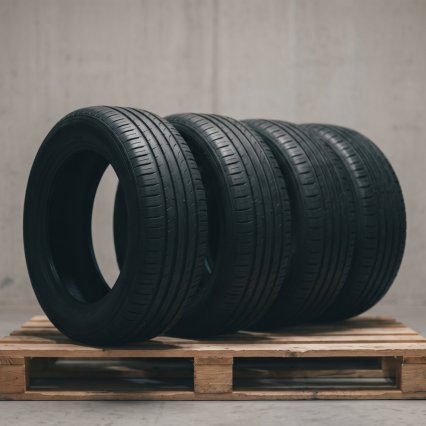
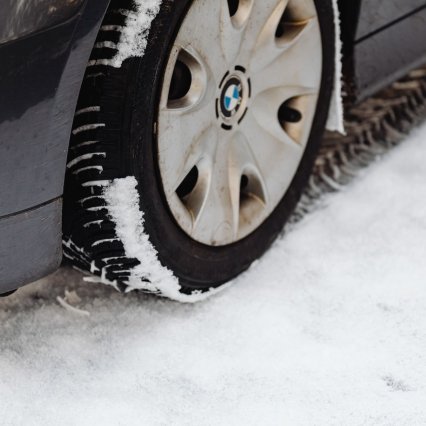
This question comes up in the shop almost every autumn, and usually along with the same conviction: if the tyre has studs, winter will be fine, while a studless tyre is supposedly hopeless on ice. The test figures deal that assumption a fairly brutal blow. In the 2024 winter tyre comparison by the Finnish magazine Tekniikan Maailma, the weakest studded tyre lost to every single studless tyre in ice braking and trailed even the second-weakest studded tyre by ten metres. Metal in the tread does not create grip on its own. What follows sets out what independent tests show about both tyre types, what the law requires in Latvia and what the choice should really be based on.
Do studs always win on ice?
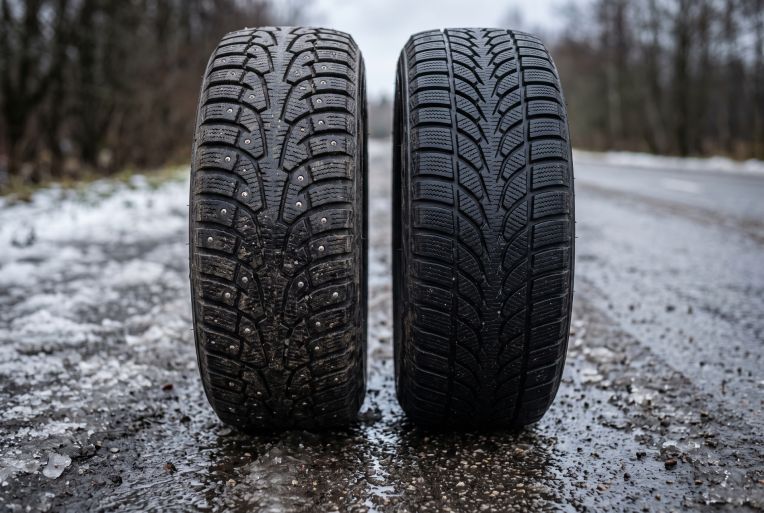
As a group - yes, but the advantage is not a fixed quantity. The Swedish National Road and Transport Research Institute VTI has tested tyres on three different ice surfaces: wet ice, dry smooth ice and dry rough ice. Studded tyres as a group stay ahead in all three cases, but the gap is very uneven - largest on wet ice, smallest on rough ice. That is exactly why two opposite experiences can be equally true: one driver has never got into trouble on studless tyres, another cannot get up a hill without studs.
The Finnish Transport Infrastructure Agency Väylävirasto compiled tyre test data from 1990 to 2022 and winter season accidents involving fatalities from 1997 to 2020. The advantage of studs on ice has barely changed across that whole period, but its size varies from 10 to 40 percent depending on the structure of the ice. The second conclusion is less well known: in cars with stability control (the system that brakes individual wheels by itself during a skid) studless tyres are safer than had been assumed, and their share, which stood at 14 percent at the time, could be at least doubled without any significant risk to road safety. Nowhere does the study claim that studless tyres beat studded ones on ice.
The most recent comparisons show the same trend. In the 2025 Tekniikan Maailma test, seven studded and seven Nordic studless tyres (the ones built for the Nordic winter rather than for wet Central European asphalt) were compared on a VW Golf in size 205/55 R16, and the best studless tyres are already starting to overtake the weakest studded ones. On ice, studs keep the advantage.
A Latvian winter is not a Lapland winter
This is where the practical part begins. The climate norms of the Latvian Environment, Geology and Meteorology Centre for the period from 1991 to 2020 show that the mean January air temperature in the country is -3.0 °C and the mean daily maximum is -0.8 °C. There is snow cover on an average of 20 days in January, its average depth is 8 centimetres, and January has become 2.3 °C warmer than in the 1961-1990 reference period. A Latvian winter therefore hovers around zero. Wet ice forms around zero. That is where studs give their biggest advantage, and it is also where grip is at its worst of all, as the Finnish road safety organisation Liikenneturva points out.
The second criterion is which roads the car actually drives on. The winter maintenance season of the state road authority Latvijas Valsts ceļi runs from 16 October to 15 April, and the main state highways are maintained to the highest class, A, during it. Roughly 10-11 thousand kilometres of gravel roads stay in the lower classes C and D: there the snow cover is deliberately kept in place and grooved when needed, grit is spread only at the most dangerous spots such as bends and climbs, and no salt is used at all.
An everyday driver in central Rīga and a driver on rural roads are therefore two completely different customers. For the first, most winter kilometres are covered on salted, bare asphalt. For the second, there is packed snow under the wheels that ices over from time to time.
Just how large the difference on ice can be is shown clearly by a manufacturer's own figures. In a Nokian comparison, a car braking from 50 km/h on ice stops in 43 metres on studded tyres and in 60 metres on Nordic studless ones. That is 17 metres, or almost four car lengths, and it is a manufacturer's result rather than an independent test, but the direction matches the VTI and Väylävirasto data. Nokian considers the most favourable range for studded tyres to be temperatures from -5 to +5 °C, which fits a Latvian winter almost exactly.
There is also an effect that an individual car owner never notices. In the field study by Malmivuo and Luoma (European Transport Research Review, 2017) each of five lanes with a different share of studded tyres in the traffic was driven 642 times at temperatures around zero: where the studded share was 50-100 percent, grip was practically the same, but in the lane with studless traffic only, ice grip turned out to be 20-31 percent lower. Studs roughen the ice for everyone, studless tyres polish it.
What the law requires in Latvia
Two periods, and they do not coincide. From 1 December to 1 March, cars and buses with a gross weight of up to 3500 kg must be fitted with tyres intended for driving in winter conditions. Studded tyres, in turn, may be used from 1 October to 1 May, which means the permitted studded period starts two months earlier and ends two months later than the mandatory winter tyre period. Section 71 of the Road Traffic Law sets a fine of 30 euros for driving without winter tyres during the winter period, and the same for driving on studded tyres between 1 May and 1 October.
- During the mandatory winter tyre period the minimum tread depth for a passenger car and a lorry up to 3.5 tonnes is 4 mm, for buses over 3.5 t it is 3 mm and for lorries over 3.5 t it is 2 mm. For the rest of the year the general 1.6 mm minimum applies to passenger cars.
- One vehicle may not have studded and studless tyres at the same time. That rules out the popular idea of studding only the driven axle: the choice applies to all four wheels at once.
- Since 1 October 2024, only a tyre with the "mountain and snowflake" or 3PMSF marking counts as a winter tyre during the mandatory period. Tyres marked with M+S alone may be used from 2 March to 30 November. The requirement is set out in Cabinet Regulation No. 295, and without that marking a car will not pass its roadworthiness test during the winter period.
Marking is not a problem in Latvia: in CSDD roadside technical checks, incorrectly marked tyres were found on slightly under 0.3 percent of vehicles. Wear is a different picture. During the 2024/2025 winter season CSDD and the State Police checked 6448 vehicles on the roads: 621 of them, or 9 percent, had a tread depth of only 4-5 mm, 178 cases were given a repeat inspection within a month, and 69 cars with dangerously worn tyres were not allowed to continue. Deadlines and measurements are covered in more detail in the article on when to change to winter tyres.
One more point: the 4 mm has to hold for the whole mandatory period, not only on the day the tyres go on. A set that reads 5 mm in November will most likely be below the limit by February, so measure before fitting.
What studs ask for in return day to day
Noise is not a small matter, and it would not be honest to keep quiet about it. VTI data show that new studded tyres are noticeably louder than studless ones, and the difference is largest at speeds below about 60 km/h - that is, in town. As the studs wear down, the gap narrows.
Fuel consumption works the opposite way to what many people expect. VTI and KTH measured the rolling resistance of 50 tyres (how much energy a tyre takes up simply by rolling) on two road surfaces under road conditions, and the difference between winter tyres with and without studs as groups turned out to be statistically insignificant. Differences between individual models mattered more.
There is a clear difference in road surface wear. A study published in the scientific journal Atmospheric Chemistry and Physics in 2019 put the surface wear caused by studded tyres at 2-5 grams per kilometre driven, and it is the main source of road dust in Nordic cities. Modelling a single street in Helsinki, it was calculated that cutting studded tyre use by 30 percent would mean 10-22 percent fewer fine dust particles (PM10) generated by the street itself. For a driver in central Rīga this argument means something, for a driver on rural roads, quite reasonably, it does not.
It is also worth understanding how much this choice decides in the first place. Across five cities between 1 January 2002 and 31 August 2009, the Norwegian Institute of Transport Economics TØI found that reducing studded tyre use changed winter accidents involving injuries by only 2-5 percent, and accidents involving property damage by less than one percent. The often quoted figure that the risk of being killed is 42 percent lower comes from Swedish Transport Administration studies cited by VTI and applies only to older cars without electronic stability control. Tyre quality and driving style change the outcome more than the presence of studs, and a stability system does not work without grip.
Two ways to make studs gentler
The main drawback of studs - metal that touches the surface even where there is no ice - is no secret to manufacturers, and two different answers have appeared in recent years. The studs of the Nokian Hakkapeliitta 01 rest on a temperature-sensitive base layer: in the cold it hardens and pushes the studs out, in milder weather it softens and lets them sink into the tread. There is no electronics in it, all of it happens in the rubber itself. At a press demonstration the magazine The Drive recorded the studs standing out at around minus five degrees and sitting sunk in at around plus five. Road surface wear the manufacturer promises to cut by up to 30 percent. We wrote about the technology in a separate article, and the Hakkapeliitta 01 itself is in our catalogue.
Continental takes a different route. The ContiFlexStud studs used in the IceContact range sit in a rubber jacket rather than an aluminium one, so the metal core can follow the road surface more flexibly and bite deeper into ice. In the manufacturer's own measurements that gives roughly 7 percent better grip on ice and roughly 20 percent less surface wear than conventional studs, and the stud noise heard inside the car is quieter. The difference from the Nokian approach matters: here the studs are always out, temperature does not move them. The technology first appeared in the IceContact 3 and is also used by the newer IceContact 8.
In both cases the figures come from the manufacturers' own measurements, and the two approaches have not yet been compared against each other in independent testing. For a buyer that means one thing: a new stud technology is an argument in a model's favour, not a guarantee that this particular tyre will beat another well-rated studded tyre.
Mistakes that cost more than the choice itself
- A set that has not been run in. Nokian states that the first 400-500 km on new studded tyres should be covered without hard acceleration, sharp braking or fast cornering, so that the studs settle into place; each stud has an indicator ring moulded around it that wears away once the tyres are run in. VTI, for its part, recommends at least 100 km and preferably 500 km, because after too short a run-in, hard braking on ice simply tears the studs out.
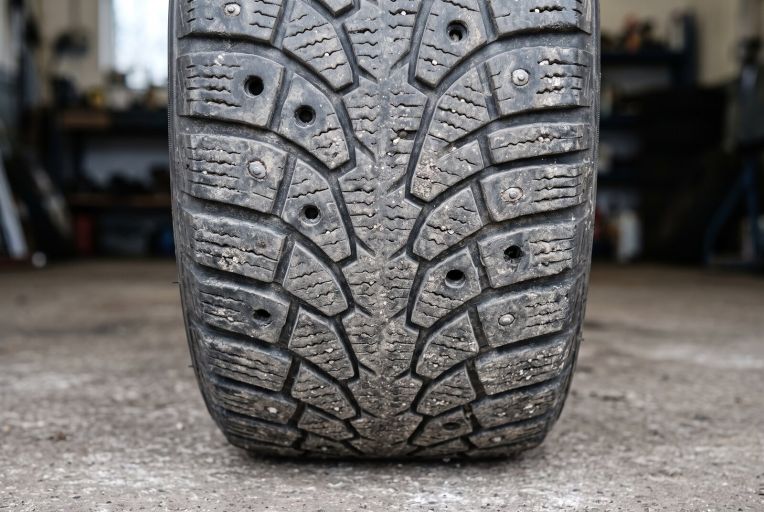
- Used studded tyres that look new. The road construction reference site Pavement Interactive notes that new studs protrude 1.2-1.5 mm above the tread, but once that protrusion shrinks to about 0.6 mm their contribution to grip is practically no longer noticeable. A legal tread depth says nothing about the condition of the studs, so it is worth counting the empty stud holes before buying. Nokian advises against refitting studs that have fallen out: the tyre itself needs replacing, and taking the studs out will not turn it into a studless tyre.
- Treating 3PMSF as a mark of quality. The snowflake is only the mandatory minimum. ADAC's 2025 winter tyre test in size 225/40 R18 examined 31 models, and 11 of them were rated "poor", even though all of them carried the Alpine symbol. In braking from 80 km/h on a wet surface, the gap between the best and the worst tyre exceeded 15 metres: where the car on Goodyear UltraGrip Performance 3 had already stopped, the car on Syron Everest 2 was still travelling at almost 46 km/h. What separates a Nordic-type ice tyre from a Central European winter tyre is the separate ice grip pictogram on the EU tyre label (the sticker on every new tyre), which under Regulation (EU) 2020/740 may only be shown on C1 tyres, that is, tyres for passenger cars. Liikenneturva converts the label classes into metres: one wet grip class means a difference of 3-6 metres in braking distance. How to read the rest of the label's ratings is explained in the guide on how to choose tyres.
- Pressure that is never checked. According to Continental, for every 10 °C the temperature drops, the pressure in a tyre falls by 0.07-0.14 bar, so a set inflated in a warm autumn is already noticeably soft in -10 °C frost. It should be measured at least once a fortnight and only on cold tyres; low pressure also speeds up stud loss.
- Rubber that is too old. The CSDD advises against using tyres more than five to six years old, because the rubber compound loses its properties over time. A hardened winter tyre no longer grips the road on ice, whether or not the studs are still in it.
- Hoping that studless tyres can be left on all year. Nokian warns that rough spring roads wear them down quickly and unevenly. Two seasonal changeovers a year are needed either way.
How to choose
The question "studded or studless tyres" is really a question about where the car is driven in winter.
Studded tyres are the logical choice if most winter kilometres are covered on untreated regional or gravel roads, if the route includes steep climbs, or if the car is parked outside and mornings start on an icy surface. In our catalogue, studded winter tyres cover rim diameters from R13 to R22, with the widest choice in the R16-R18 group, and several dozen brands are represented.
Studless Nordic-type tyres are a better fit if the driving is mainly urban on salted asphalt, or if the mileage is high and noise becomes a nuisance. Another reason is trips abroad: studded tyres are banned or restricted in several Central and Western European countries, Germany among them, so the rules at the destination should be checked before setting off. In the winter tyres section, studless models are far more widely represented - roughly four studless models for every studded one.
Many people buy the third option by accident. As Nokian explains, Central European winter tyres are noticeably weaker on snow and ice than Nordic-type studless tyres, but better on wet asphalt. Both are sold simply as winter tyres, so what to look at is the ice grip pictogram, not the name. Every winter tyre in our catalogue carries the 3PMSF marking, so any of them meets the legal minimum.
The main thing the tests show: the gap between a good tyre and a bad one tends to be larger than the gap between a tyre with studs and one without. In Tekniikan Maailma's 2024 test the weakest studded tyre finished 19.5 metres behind the best result in ice braking. So it is worth choosing on test results, not on whether there is metal in the tread.