A tyre ages even when nobody is driving on it. So it does matter where a set spends the six months between seasons - a balcony, a shed, a cellar and a garage next to the compressor mean completely different things for rubber. In spring you do not notice the difference, because the tyres look exactly the same as they did in autumn, but the bill arrives later. Preparation, a suitable place and the right way of stacking decide whether the set will last another season.
What to do before the set goes on the shelf
Before taking the wheels off, ADAC recommends marking each one with its position on the car, using chalk, stickers or labelled valve caps. Two letters are enough: FR for front right, RL for rear left. Next season it will be clear how to swap the wheels around so that wear evens out.
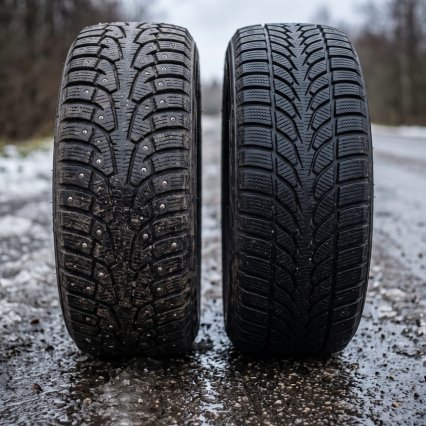
Next comes washing with water, a brush and a mild detergent. Continental's guidelines say that tyres must be cleaned and completely dried before storage, but that they need no dressings or tyre shine products. Pick stones and other foreign objects out of the tread grooves. If you are storing complete wheels, clean the rims too: road salt stays on a winter set and corrodes both the rim coating and the studs over the months in storage. That is exactly why washing matters more for winter tyres than for a summer set, and on studded tyres the salt has to be rinsed off especially thoroughly. On the shelf, studded and studless tyres are stored in exactly the same way.
A pressure washer is fine, but the jet must not be held right against the tyre. ADAC's material states that you should work from at least 50 cm away. Manufacturers warn that a jet held too close can separate the rubber from the layers underneath, and the damage will only show up once the tyre is back on the road.
A dry tyre is worth inspecting closely. This is the moment to spot what could become expensive next season:
- bulges or dents in the sidewall;
- deep cracks in the tread, shoulder or sidewall, as well as a network of fine surface cracks showing that the rubber has begun to dry out;
- damage that exposes the cords;
- missing studs and uneven wear;
- tread depth on every tyre separately, not just on one.
Where tyres keep well and where they do not
Nokian Tyres' storage recommendations set a specific limit: the room temperature must stay below +25 °C, while a dark, cool place below +15 °C is ideal. Above +25 °C or below zero the properties of the rubber can change. Temperature stability matters too, because large swings stress the structure of the rubber, and the company's 2026 article notes that the right conditions can give tyres up to one extra driving season.
Continental is categorical on this point: tyres are never stored outdoors, not even under a cover. A cellar or another climate-controlled room is best, because in most garages, sheds and lofts the temperature and humidity fluctuate far too much. In Latvia this is easy to check for yourself: in an unheated garage or on a balcony the temperature regularly drops below zero in winter, while in summer the sunny side warms up well above +25 °C. Both extremes fall outside the range the manufacturers recommend. If the tyres do have to stay outside, the Tire Industry Association advises raising them off the ground and covering them with an opaque, waterproof cover that has ventilation openings, so that moisture does not build up underneath.
Humidity must not be so high that condensation forms on the tyres, and strong UV radiation makes rubber brittle and less elastic; Nokian highlights both points separately. A dark room takes the whole question off the agenda.
Ozone is often forgotten as well. The same manufacturer's recommendations state that the storage room must not contain fluorescent or mercury vapour lamps, high-voltage equipment, electric motors or other devices capable of sparking. The Tire Industry Association adds battery chargers, welding equipment and generators to the list. In its guidance for motorcycle and scooter tyres, Continental even quotes a numerical ozone limit of 0.08 ppm and adds that ordinary incandescent bulbs are better for lighting the room than fluorescent lamps; the brand does not publish these figures separately for passenger car tyres, but the principle is the same.
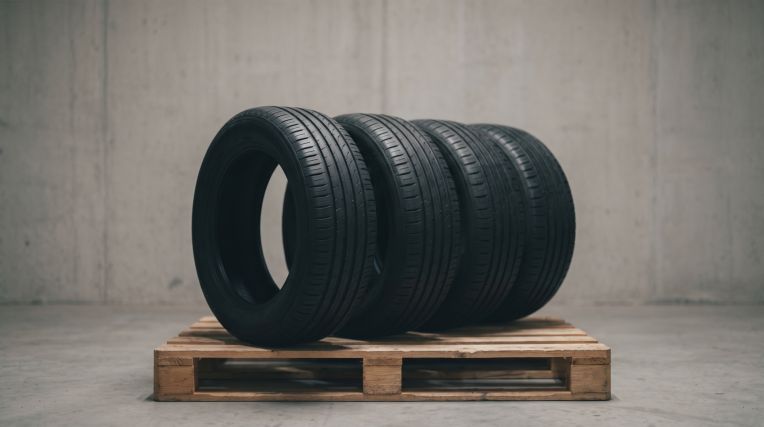
What the tyres stand on matters too. Put them on a pallet or a shelf rather than straight on the floor, says the Tire Industry Association, and there should be no oil stains, nails or stones underneath them. The room must be ventilated, but with minimal air movement. Keep fuel, oils, solvents and paints in another corner. And one more everyday mistake: a tyre is neither a workbench nor a shelf, so do not stack anything on top of it.
On the rim or off the rim: two opposite rules
On this point Michelin, Continental, Nokian, ADAC and the Tire Industry Association speak with one voice, so it can be treated as the industry consensus.
- Tyres without rims are stored upright, standing on the tread. Never stack them and never hang them, because without a rim a tyre deforms under its own weight; Nokian warns that prolonged deformation can cause cracks when the tyre is inflated after storage. Turn them every few months so that flat spots do not form, ADAC advises.
- Complete wheels are laid flat in a stack or hung on wall hooks and racks, but not stood upright. Michelin's guidelines put two limits on a stack: no more than two tyres one on top of the other, and no higher than 1.20 m.
One more detail from Nokian: a tyre must not be dropped from a height of more than about 1.5 m - the fall can bend the bead.
Bags are a topic of their own. Continental recommends putting each tyre into a large airtight plastic bag, drawing out as much air as possible with a vacuum cleaner and taping the bag shut, while Michelin mentions a sealed bag as a way of limiting exposure to ozone. There is one condition: the tyre must be completely dry, because moisture in the bag turns into condensation, and that harms both the rubber and the rim.
The pressure the recommendations disagree on
There is no single right answer here. For tyres mounted on rims, Michelin recommends lowering the pressure below the normal driving level before storage, but not to zero, to reduce the load on the structure. The Tire Industry Association names a specific figure, 50 % of normal pressure, while Continental's motorcycle tyre guidance quotes 100 kPa, or 15 psi. ADAC goes the opposite way: the club advises raising the pressure by 0.5 bar above the manufacturer's figure before the tyres are put into storage, to compensate for the natural loss of air. In a statement of 16 November 2018, Nokian product manager Martin Dražík recommends increasing the pressure slightly only if the tyres are stacked, because the bottom tyre carries the weight of all the others.
Everyone agrees completely on only one thing: before driving, the pressure must be restored to the level specified by the car manufacturer. ADAC's figures on everyday use help explain why this is not a formality. An undamaged tyre naturally loses about 0.1 bar over three months, which is why the pressure should be checked every two weeks, measuring cold tyres at an outside temperature of around 20 °C. Being just 0.5 bar below the specified value can lengthen the braking distance and worsen cornering behaviour, while fuel consumption can rise by up to 0.3 l per 100 km.
Is this set even worth storing
Storage costs either money at a service centre or space at home, and sometimes the sensible move is to replace the set rather than put it away. Such a decision is easier to make in spring than in November, when the tyres are needed by tomorrow.
Start with age. ADAC explains that the production date is read from the last four-digit block of the DOT number: the first two digits are the week, the last two the year, so 1024 means the tenth week of 2024. The date is usually stamped on only one side of the tyre, so check both. Rubber ages even if the tyre has never been on the road: the club compared five summer and five winter tyre models in freshly manufactured condition with three-year-old, unused tyres of the same models and concluded that the rubber compound hardens over the years in storage as well. Braking on wet surfaces and performance in snow suffer the most.
The limits the industry recommends are similar, but not identical:
- Continental: a correctly stored, unused passenger car tyre still counts as new up to 5 years of age, but the manufacturer recommends replacing anything older than 10 years;
- Michelin: at 5 years the tyre should be inspected and at 10 years replaced, and the count starts from the date of manufacture regardless of whether the tyre has been driven on or has stood in a warehouse;
- ADAC: replacement after 8-10 years regardless of tread depth, and winter tyres start losing part of their winter performance from around 6 years of age, so using them beyond 8 years is not advisable;
- the German tyre trade association BRV: under the right conditions a tyre counts as factory new up to 3 years of age and simply new up to 5 years;
- CSDD: in Latvia tyre age is not restricted by law, but the advice is not to use tyres older than 5-6 years.
What age costs on the road is shown by the special tyre test run by the Swiss automobile club TCS on 22 March 2011 with summer tyres between two and fourteen years old that had around 5 mm of tread left. Braking on a wet surface from 80 km/h, a five-year-old tyre needed 6 metres more than a new one. At the point where the new tyre had already come to a stop, the old one was still travelling at 30 km/h.
The second criterion is the tread. In Latvia, during the winter period, winter tyres on passenger cars and lorries with a gross weight of up to 3.5 t must have a tread at least 4 mm deep, while outside the mandatory winter tyre period the minimum is 1.6 mm; CSDD is the source of both figures. How close to the limit many people drive is shown by the same authority's summary of 1 March 2024: during the 2023/2024 winter season roadside technical checks covered 9,173 vehicles, and in 807 cases, or 9 % of them, the tread depth was only 4-5 mm, while 94 cars with critically worn tyres had their registration plates removed.
ADAC recommends changing even earlier: winter tyres once the tread drops below 4 mm, summer tyres from 3 mm. For summer tyres that is considerably more than the 1.6 mm required in Latvia, while for winter tyres the recommendation matches the statutory minimum. In the club's 2023 test with tyres worn down to 2.5 mm, braking on a wet surface deteriorated by up to 23 %, traction on snow fell by 15-35 %, and in emergency braking from 30 km/h on snow the braking distance grew by up to 3.5 metres. If you can already see in spring that there will not be enough tread left for next season, there is no point in storing the set. We have described how to choose the next one in a separate guide.
At home, in the garage or at a tyre hotel
Not everyone has a dry cellar with a stable temperature. Managers of apartment buildings often do not allow tyres to be kept in the cellar for fire safety reasons, and then the choice narrows to an insulated garage or a tyre hotel. For comparison: according to ADAC's summary, professional storage in Germany costs around 30 to 60 euros per set per season, that is, for six months.
When you hand your tyres over to a service centre, fill in a handover record with the tyre model, size, tread depth, condition and position on the car, and have it signed. That is the only proof you can rely on if something does not add up in spring. A second set of rims pays for itself sooner than it seems: the seasonal changeover costs less, and the tyre bead is not stressed by being remounted twice a year. Ready-mounted wheels are also easier to store at home.
A car that stands in one place for a long time with its tyres fitted is a separate case. The best solution is to raise it onto stands. If that is not possible, the Tire Industry Association recommends increasing the pressure by 25 % above the level required for a loaded car, without exceeding what the rim manufacturer allows, then unloading the car and moving it at least once every three months so that flat spots and ozone cracks do not form in the flex zone of the tyre sidewall. The parking spot should not be on black asphalt. Most temporary flat spots, as Michelin points out, disappear after more than 20 minutes of driving at motorway speed.
Before you put the tyres back on
There is no need to rush the switch from winter tyres to summer ones until spring weather has settled and the air temperature stays consistently above +5 to +7 degrees, the CSDD reminds drivers. In practice, that is what decides when the winter set goes into storage and when it comes back out. We have summarised the deadlines and requirements for the winter period in our article on the legal requirements for winter tyres.
- Inspect every tyre once more, just as you did in autumn.
- Restore the pressure to the level specified by the car manufacturer, including the spare wheel.
- Fit the wheels according to the marks you made in autumn and swap them around so that wear evens out.
- If you have several sets, start with the one that has been in storage longest, the Tire Industry Association advises.
- Check that the TPMS sensors are working.
- After a few dozen kilometres, retighten the wheel bolts.
None of these steps takes much time. Together they decide whether, six months later, you find on the shelf the same tyre you put there.