In Latvia the law sets two limits for tread depth: 1.6 mm for most of the year and 4 mm for winter tyres from 1 December to 1 March. If a passenger car's tyres are down to 3.9 mm in winter, the car gets only a temporary permit at the roadworthiness test, and with less than 3 mm it may no longer be driven. Worn tread is also dangerous: with tyres worn down to the legal minimum, the braking distance from 100 km/h on a wet road can be almost twice as long. This article explains how deep the tread must be in summer and in winter, how to measure it yourself and when it is time to replace your tyres.
Minimum tread depth in Latvia: 1.6 mm, 4 mm in winter
The Road Traffic Regulations prohibit driving on tyres whose tread is thinner than the permitted minimum, but the millimetre figures themselves are set by Cabinet Regulation No. 295 on state roadworthiness tests and roadside technical checks. The minimum depends on the season and the type of vehicle.
| Vehicle | Outside the winter period | 1 December - 1 March |
|---|---|---|
| Passenger cars and vans up to 3.5 t | 1.6 mm | 4 mm (winter tyres) |
| Buses | 2.0 mm | 3.0 mm (over 3.5 t) |
| Lorries over 3.5 t and their trailers | 1.6 mm | 2.0 mm |
For car trailers the minimum is 1.6 mm, and for motorcycles 0.8 mm. The winter period is the same as the mandatory winter tyre period for passenger cars. A few details are often overlooked:
- The tread must be at least 4 mm throughout the winter, not just on the day the tyres go on. If winter tyres have about 5 mm in autumn, the tread can wear below the permitted depth by February.
- Since 1 October 2024, only tyres with the 3PMSF marking (the three-peak mountain snowflake symbol) are accepted in the winter period; M+S alone is no longer enough. Every winter tyre in our catalogue carries this marking.
- Outside the winter period, 1.6 mm is enough for winter tyres too. That is only the minimum, though; the point at which it is advisable to replace them is covered below.
- Requirements differ in other countries: in Finland the minimum for winter tyres is 3 mm, in Austria and the Czech Republic 4 mm, and in Germany 1.6 mm all year round. Before a winter trip abroad, check the rules of the country you are heading to.
Roadworthiness test grades and the fine for insufficient tread
At the roadworthiness test and at roadside checks, tread is assessed in the same way:
- if, in the winter period, a passenger car up to 3.5 t has at least 3.0 mm of tread but less than 4 mm, that is a grade 2 fault. The car gets only a temporary permit and has to be brought back for a repeat test;
- if, in the winter period, the tread is less than 3.0 mm deep or the car is on summer tyres, that is a grade 3, or dangerous, fault. Such a car may not be driven on public roads, its roadworthiness certificate is cancelled, and at a roadside check the number plates are removed;
- outside the winter period, tread of less than 1.6 mm is a grade 2 fault.
For insufficient tread or dangerous tyre damage, the Road Traffic Act provides for a warning or a fine of €15 to €55 for the driver. Driving without winter tyres from 1 December to 1 March carries a €30 fine, and the fine is the same for driving on studded tyres from 1 May to 1 October.
These checks are carried out regularly. In the winter of 2025/2026, CSDD and the State Police checked 8,216 vehicles on the roads. In 627 cases, or 8%, the tread was right at the minimum limit, and those drivers received a warning. Another 195 cars were given a grade 2: their roadworthiness certificate was cancelled and they had to pass a repeat check within a month. The number plates were removed from 54 cars whose tyres were so worn that they could only be taken away from the checkpoint by tow truck. A further 17 drivers were still on summer tyres.
The fine itself is not the biggest expense. The tow truck and the repeat test cost more, and most expensive of all are new tyres that have to be bought in a hurry in mid-winter, when there is no time to choose carefully.
Braking distance on worn tyres: what the tests show
The legal minimum only tells you when you may no longer drive on the tyres. It says nothing about how safe it is to drive on them until they reach that limit.
On dry asphalt the tread grooves make almost no difference. On a wet road, though, they carry water away from where the tyre touches the road. According to Continental's data, a new tyre at 80 km/h channels away up to 30 litres of water per second. As the tread wears, the grooves get shallower and drain water less effectively. If the water can no longer escape, the tyre loses its grip on the road and aquaplaning begins.
In Auto Bild's 2026 test at Continental's proving ground, two VW ID.3 cars were compared, both on Continental PremiumContact 7 summer tyres made in the same week. One car had new tyres (about 7.5 mm), the other had tyres worn down to 1.6 mm. Braking on a wet road from 80 km/h, the car on new tyres stopped in 26 m and the one on worn tyres in 37.5 m. By the time the first car had stopped, the second was still travelling at 44 km/h. From 100 km/h the braking distance was almost twice as long: 77.5 m against 40 m.
Braking performance deteriorates well before 1.6 mm, and not at a steady rate. In Continental's measurements, compared with a new 8 mm tread, the braking distance was 2.2 m longer at 3 mm and as much as 6.8 m longer at 1.6 mm. Philipp Must, an engineer at Continental, explains that wet braking gets sharply worse from about 3 mm, and below 2 mm the risk of aquaplaning also rises steeply.
For winter tyres, ADAC's 2026 test shows this clearly. It tested five winter tyre models in size 185/65 R15 when new (about 8 mm), worn down to 4 mm and worn down to 2 mm. The wet braking distance in a straight line hardly changed at 4 mm (31.9 m for new tyres, 31.4 m for worn ones), but that gives a misleading picture. Aquaplaning resistance in a bend was about 25% lower at 4 mm and more than halved at 2 mm. On snow, braking from 30 km/h was 12.4% worse at 4 mm and 20.5% worse at 2 mm, while on a wet road the braking distance grew to 37.3 m at 2 mm. So wear first takes its toll on the car's stability in bends on wet roads and on snow, and only later becomes noticeable when braking in a straight line.
The Luxembourg automobile club ACL applied these figures to an everyday situation: a car is travelling at 80 km/h when an obstacle appears 30 m ahead. On new tyres the car hits it at about 15 km/h; on tyres worn to 2 mm, at about 37 km/h. A premium tyre with 2 mm of tread did worse than a mid-range tyre with 4 mm. An expensive brand does not make up for wear.
Not every manufacturer recommends replacing tyres early. Michelin, having studied 128,000 tyres taken out of service, concludes that half of them are replaced before the tread reaches 3 mm, and considers replacing tyres before the legal minimum costly and harmful to the environment. In practice the two views can be combined: it makes sense to replace summer tyres at about 3 mm, while for winter tyres in Latvia 4 mm is required by law.
How to measure tread depth
You need a tread depth gauge. It costs a few euros, and only a gauge lets you tell 3.9 mm from 4.1 mm. In winter, those two tenths of a millimetre decide whether you get a grade 2 at the roadworthiness test.
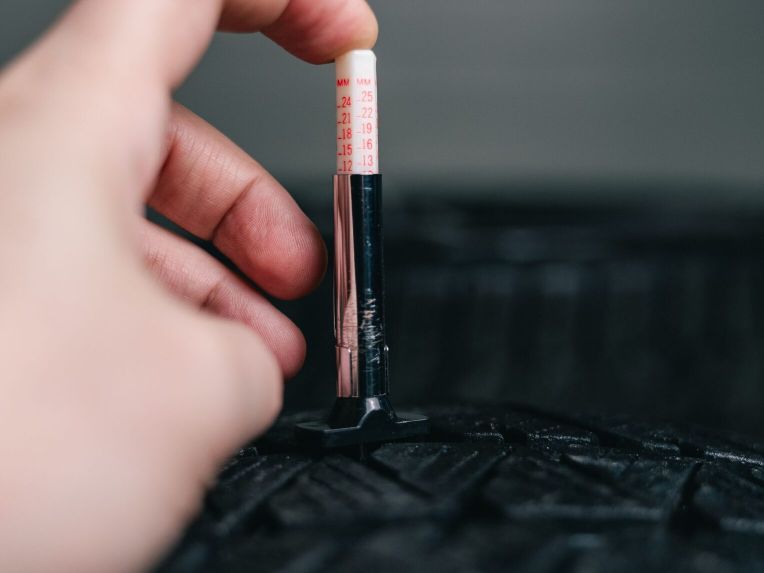
- Find the main grooves. These are the wide circumferential grooves in the central part of the tread, which covers about three quarters of its width. Do not put the gauge into the narrow sipes or on the wear indicator bars at the bottom of a groove.
- Measure the inner, centre and outer groove at several points around the tyre. On the front wheels, turn the steering to full lock: the inner edge can be worn in a way that cannot be seen from the outside.
- The tyre's tread depth is the lowest value measured. If the tread is shallower in one spot than elsewhere, that spot is what counts.
- Write down each tyre's reading and the date. After the season you will be able to see how fast the tyres are wearing and whether all four are wearing evenly.
If you have no gauge, you can check the tread roughly with a coin. The gold rim of a one-euro coin is slightly wider than 3 mm, so it works for summer tyres, while the silver rim of a two-euro coin is about 4 mm wide and works for winter tyres. Put the coin into a main groove: if you can see the rim, the tread is below that limit. If the result is borderline, a coin is not accurate enough and it is better to measure with a gauge.
It is worth checking the tread before every seasonal tyre change, before a long trip and whenever vibration or an unusual noise appears while driving. If you inspect your tyres once a month, you will also spot uneven wear in time.
The TWI wear indicator only shows the 1.6 mm limit
At the bottom of the main grooves, in about six places around the tyre, there are raised bars 1.6 mm high. These are the wear indicators, or TWI (Tread Wear Indicator). Their position is marked on the sidewall by the letters TWI, or by a small Bibendum figure on Michelin tyres. If the tread has worn down to the level of the bars in even one place, the 1.6 mm limit has been reached and the tyre must be replaced.
For a Latvian winter that is not enough. The TWI shows the limit that applies outside the winter period, but in winter a passenger car needs at least 4 mm. So a winter tyre will fail the roadworthiness test long before its tread has worn down to the TWI bars. Many winter tyres have a second indicator at 4 mm, sometimes marked with a snowflake. Once the tread has worn down to it, the tyre is no longer fit for winter. If there is no such indicator, measure the tread with a gauge.
When to replace tyres
New passenger car tyres usually have 7-9 mm of tread, and winter tyres up to 10 mm. The last few millimetres before the legal minimum are only a small part of the tread, but it is precisely in those millimetres that the braking distance grows the most. That is why it is advisable to replace tyres before they reach the legal minimum:
- summer tyres - at 3-4 mm. Below 3 mm, the braking distance on a wet road lengthens ever more quickly and the risk of aquaplaning rises;
- winter and all-season tyres - at 4 mm. In Latvia that is also the legal minimum for winter tyres, so in autumn the tread needs enough margin to last until the end of February;
- age is a separate criterion. Tyres more than 5 years old are worth showing to a specialist. ADAC recommends taking winter tyres older than 8 years out of use and replacing summer tyres after 10 years at the latest, even those that have covered few kilometres. The year of manufacture can be read from the DOT code on the tyre sidewall, and how to decode it is explained on the page about tyre markings and indices. To keep tyres from ageing before their time, store them properly between seasons;
- damage - a tyre must be replaced regardless of tread depth if it has ageing cracks, exposed cords, a bulge or tread separation.
In Latvia, only tyres marked "Regroovable" or with the Ω symbol may have their tread grooves recut. On ordinary passenger car tyres this is prohibited, as is changing the tread pattern.
How to make your tyres last longer
Uneven wear usually means something is wrong with the car. If the problem is not fixed, new tyres will wear the same way too:
- the centre is more worn than the edges - the pressure is too high;
- both edges are worn - the pressure is too low;
- one edge is worn - the wheel alignment needs checking;
- wavy or cupped wear - the suspension needs checking;
- patchy wear - the wheels are out of balance.
It is a good idea to swap the wheels between the axles every 6,000-9,000 km, or when the difference in wear reaches 2 mm. That way the tyres wear evenly, and the whole set can be replaced at the same time.
If only two tyres need replacing, the newer ones go on the rear axle. Replacing two tyres at once is safer than replacing just one. In Latvia, the tyres on each axle of a passenger car must match in size, manufacturer, model and tread pattern, and they must either both have the 3PMSF marking or both be without it. Studded and studless tyres must not be mixed on the same car.
Tyre costs are better judged by mileage than by price. In ADAC's 2026 summer tyre test (225/50 R17), projected mileage ranged from about 26,000 km to 57,800 km, so the best tyre was expected to cover more than twice the distance of the worst. Once the price is worked out per kilometre driven, more expensive tyres can turn out to be cheaper.
Driving on winter tyres in summer does not pay off either. In ADAC's measurements on a dry road, the braking distance from 100 km/h was up to 16 m longer on winter tyres than on summer tyres. If you do use winter tyres in warm weather, do so only in spring or autumn and with more than 3 mm of tread.
A short pre-season checklist
- Measure each tyre in the three main grooves at several points and write down the lowest reading.
- Before 1 December, winter tyres need enough tread above 4 mm to last until March. Summer tyres are best replaced at around 3 mm.
- Check that the winter tyres carry the 3PMSF marking, read the DOT code and inspect the sidewalls: cracks, bulges or exposed cords mean the tyre must be replaced regardless of its tread depth.
- If the tyres are wearing unevenly, check the pressure and the wheel alignment first, and only then buy new tyres.
When it is time to replace your tyres, you can search the winter tyre and summer tyre catalogues by your size, and the year of manufacture is listed for every tyre.