If the pressure in a tyre is 0.5 bar lower than it should be, you usually cannot see it from the outside, and few drivers notice it while driving. Yet such a tyre wears faster, the car uses more fuel, and on a wet road the braking distance is longer. This article explains where to find the recommended pressure for your car, how to measure it correctly, when the pressure needs adjusting (in winter, with a full load, after a wheel change) and what TPMS sensors tell you.
Why the right pressure matters
When the pressure is too low, the tyre flexes more as you drive, its rolling resistance is higher and it wears more at the edges. According to ADAC's calculations, a tyre wears faster even when the pressure is 0.4 bar below the recommended value, and fuel consumption can rise by 0.3 l/100 km. With the pressure 0.5 bar too low, handling suffers as well: the braking distance gets longer and the car responds less well to the steering in corners.
Tyre life takes the biggest hit. Michelin's figures show that a tyre that is constantly 20% underinflated wears out about 20% sooner. A tyre that was meant to cover 40,000 km loses around 8,000 km, and fuel consumption goes up as well. On a wet road the consequences are more serious. The same manufacturer has calculated that on tyres 1 bar short of the correct pressure, the braking distance in the wet can increase by 11 m, while the extra fuel used over a year comes to roughly one full tank.
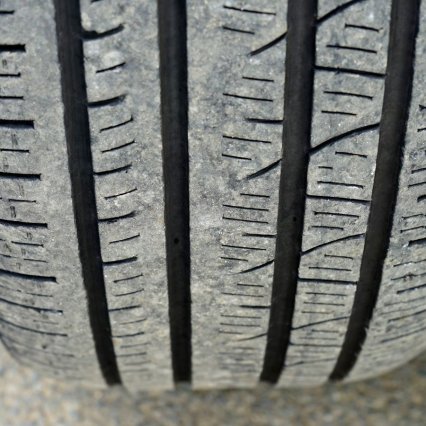
Too much pressure is not good either. If a tyre is inflated to the maximum pressure stated on its sidewall, the car rides more harshly and holds the road less well. Over time, the wrong pressure also shows up in the way the tread wears:
- worn on both edges - the pressure was too low;
- worn in the centre - the pressure was too high.
Where to find the right pressure for your car
The correct pressure is set by the car manufacturer, and it is not the number on the tyre. The MAX PRESS marking on the tyre sidewall shows the maximum permitted pressure, not the recommended one. The roadworthiness test rules (Cabinet Regulation No. 295) also require tyre pressures to match the values specified by the vehicle manufacturer.
| Location | What it shows |
|---|---|
| Driver's door frame or B-pillar | A sticker with the pressures for the front and rear axles, often for a full load too |
| Inside the fuel filler flap | The same pressure table - on many cars, this is where you will find it |
| Glovebox | A sticker on some models |
| Owner's manual | The full table, including the spare wheel |
| Car manufacturer's tables online | If the sticker is no longer legible |
| Tyre sidewall (MAX PRESS) | Only the maximum permitted pressure |
| Vehicle registration certificate | It does not state the tyre pressure |
The sticker usually shows several values. They can differ between the front and rear axles, and separate pressures are given for a normal and a full load, for example when the car is full of passengers, the boot is loaded or a trailer is attached. On the same car, these values can differ by up to 1 bar. Some manufacturers also give an ECO value or a pressure for sustained high-speed driving. Once the car has been unloaded, lower the pressure back to the normal value.
Cars that left the factory on standard load tyres are often fitted with XL tyres later. About two thirds of the passenger car tyres in our catalogue are XL versions. To carry the same load, an XL tyre needs a higher pressure: according to Continental, about 0.4 bar more at full load than a standard tyre of the same size. The load index must not be lower than the car manufacturer requires, and at the roadworthiness test an insufficient load index is a grade 2 fault. What XL and the indices mean is explained on the page about tyre markings and indices. If the sticker gives no pressure for the size you have fitted, ask a tyre fitter rather than trying to guess.
Commercial vehicle C tyres with a dual load index (for example 109/107) have separate pressure tables, and passenger car values do not apply to them.
Bar, kPa and psi: unit conversion table
The sticker may give the pressure in bar, kPa or psi, often in all three units. One bar equals 100 kPa, or 14.5 psi, while 1 psi is roughly 0.069 bar.
| bar | kPa | psi |
|---|---|---|
| 1.0 | 100 | 14.5 |
| 2.2 | 220 | ~32 |
| 2.4 | 240 | ~35 |
| 2.5 | 250 | ~36 |
Before inflating your tyres at a petrol station, check which units the air compressor displays. If the sticker says 2.4 bar but the compressor is set to psi, you need about 35 psi. When the sticker gives the pressure in kPa but the pressure gauge reads in bar, divide the value by 100.
How to measure the pressure correctly, and how often
The manufacturer's values apply to cold tyres. A tyre counts as cold if the car has been parked for at least two hours or has covered less than 3 km at low speed. Driving warms up the air in the tyre, so straight after a journey the gauge reads about 0.3 bar higher than in the morning.
- Measure before setting off, or once the car has been standing for a couple of hours.
- Always use the same gauge, so that the readings are comparable.
- Press the gauge straight onto the valve. If you hear hissing, the connection is not airtight and the reading is not accurate.
- Compare the readings with the sticker, separately for the front and rear axles and according to how heavily the car is loaded.
- If you have to measure warm tyres, do not let any air out. Inflate them to the manufacturer's value plus 0.3 bar and check again once the tyres have cooled down.
- Screw the valve cap back on. If a cap is missing or a valve is worn, replace it straight away. Tyre valves and caps are available in our catalogue.
Check the pressure every 2-4 weeks, as well as before a long journey and before carrying a heavy load. Even a sound tyre gradually loses air, about 0.03-0.1 bar a month. If the pressure has not been checked for six months, it will almost certainly be too low, even if the tyre is not punctured.
Filling tyres with nitrogen is not worth it. Air already contains about 78% nitrogen, filling four tyres with nitrogen costs around €10, and ADAC considers it an unnecessary expense. Nitrogen-filled tyres need their pressure checked just as often.
Check the spare wheel pressure once or twice a year. A compact temporary spare (T-type) usually needs a considerably higher pressure than the regular wheels. In a Kia owner's manual, for example, it is 420 kPa (4.2 bar), and you must not exceed 80 km/h on it. Look up the value for your own car in its owner's manual.
Tyre pressure in winter: why the TPMS light comes on with the first frosts
In the cold, the air pressure in a tyre drops by about 0.07-0.14 bar for every 10 °C.
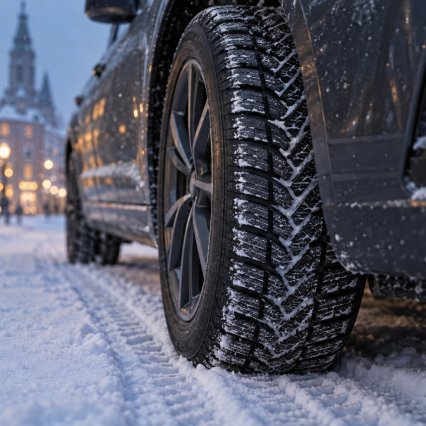
Here is what often happens in autumn: the wheels are changed in a warm workshop or garage at +20 °C and the pressure is set precisely, but a few days later it is -10 °C outside in the morning. With a 30-degree difference, the tyre pressure drops by about 0.2-0.4 bar. That is why the TPMS light so often comes on the first cold morning after a tyre change. After a wheel change, it is worth checking the pressure again outdoors when the tyres are cold. If the tyres are inflated indoors but around -10 °C is expected outside, Nokian recommends inflating them about 0.3 bar higher.
Do winter tyres need a higher pressure? If the car manufacturer gives a separate winter value, follow it. If there is none, the advice differs: Nokian recommends 0.2 bar more in winter tyres than in summer, while Continental sticks to the value the car manufacturer specifies. ADAC explains that manufacturers usually state the minimum pressure, and 0.2 bar more hardly affects comfort but does reduce fuel consumption. In practice:
- follow the value on the sticker, including the winter or full-load value if there is one;
- 0.2 bar above the sticker value is acceptable;
- never exceed the maximum pressure stated on the tyre sidewall.
Correct pressure matters just as much for studded tyres as for studless ones. If the tyres are not looked after properly, the studs can fall out sooner.
In Latvia, passenger cars up to 3.5 t must have winter tyres from 1 December to 1 March, and driving on studded tyres is prohibited from 1 May to 1 October (Road Traffic Regulations). The spring and autumn tyre change is a good opportunity to check the pressure and the TPMS as well.
TPMS tyre pressure sensors: what they show
Since 1 November 2014, no new passenger car may be registered in the EU without a tyre pressure monitoring system, which is why almost all recent cars have TPMS. However, TPMS only warns of a drop in pressure and does not replace a pressure gauge.
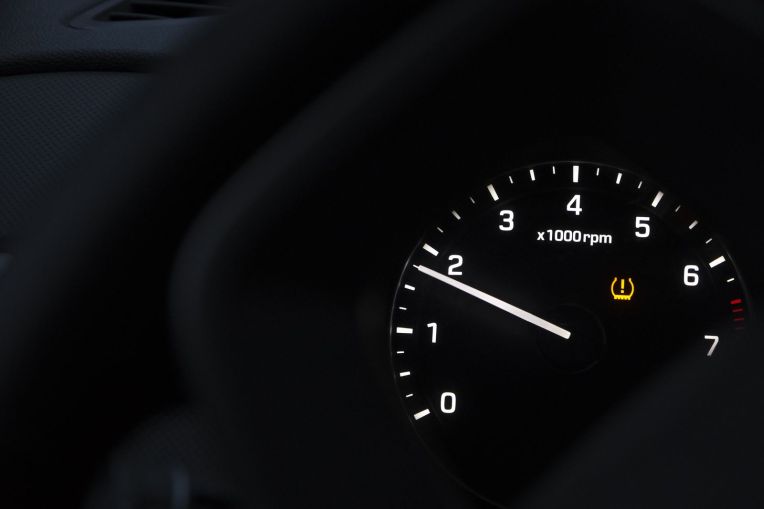
Under the EU type-approval requirements (UN Regulation No. 141), the TPMS light must come on within 10 minutes of the pressure in one tyre dropping by 20% or to 150 kPa, whichever threshold is higher. If the recommended pressure is 2.2 bar, the light is only required to come on at about 1.76 bar. That is roughly 0.4 bar less, which is already enough to make the tyre wear faster and the car use more fuel. If the light stays off, that does not necessarily mean the pressure is right.
Direct and indirect TPMS
In a direct system, a sensor in each wheel, powered by its own battery, measures the pressure. An indirect system has no sensors: it detects a pressure drop from differences in wheel rotation speed measured by the ABS, and usually only warns once the pressure has fallen by about 30%. The difference also shows up in research. In a study published by Dekra in 2018 and commissioned by Transport & Environment, car tyres were checked in Rome and Lisbon. At least one tyre was 0.3 bar or more below the correct pressure on 41% of cars without TPMS, 31% of cars with an indirect system and 28% of cars with a direct system.
With an indirect system, the most important thing is to reset it correctly. First set the correct pressure, and only then run the system reset, also called calibration, from the car's menu. If you do it while the tyre pressure is too low, the system accepts that pressure as normal. Repeat the calibration after every wheel change and pressure adjustment, even if the wheels have only been swapped around.
Winter wheels without sensors and the roadworthiness test
If your car has a direct system, the second set of wheels needs sensors too, and they may have to be programmed or paired with the car. Without sensors the warning light will stay on all season. In Latvia this also matters for the roadworthiness test. On category M1 cars first registered on or after 1 January 2018, the TPMS must work if the manufacturer fitted one. If the system does not work, it counts as a grade 2 fault at the roadworthiness test and at roadside checks, and the car gets only a temporary permit until the fault has been fixed.
A sensor battery lasts about 5-10 years, after which the whole sensor is usually replaced. Sensors for the winter wheels will last several seasons, and spare you a repeat roadworthiness test. In the TPMS sensors section you will find sensors with clamp-in (screw-on) or snap-in (rubber) valves, in 433 MHz and Bluetooth versions, some of them programmable. The section also has valve service kits and diagnostic tools.
If the TPMS light comes on while you are driving, stop somewhere safe and inspect the tyres. Do not drive on if a tyre is visibly flat; otherwise, drive to the nearest petrol station and measure the pressure in all four tyres. With RunFlat tyres you often cannot feel the drop in pressure after a puncture at all, so on cars fitted with them the TPMS is the main warning.
When to check and adjust the pressure
| When | What to do |
|---|---|
| Every 2-4 weeks | Measure the cold tyre pressure and adjust it to the value on the sticker |
| Before a long journey | Check all four tyres |
| Fully loaded car, trailer or roof box | Inflate to the full-load value and reduce it to the normal value afterwards |
| After the seasonal wheel change | Set the pressure, then reset or check the TPMS |
| First frosts or sudden temperature changes | Check the pressure outside while the tyres are cold |
| TPMS light comes on | Inspect the tyres and measure the pressure at the nearest petrol station |
| After a tyre repair | Measure the pressure and calibrate the TPMS if needed |
| Spare wheel | Check once or twice a year against the value in the owner's manual |
In short
- Find the sticker in the door frame or inside the fuel filler flap and take a photo of it, so you always have the values to hand.
- Check the pressure of cold tyres with your own gauge every 2-4 weeks, and in winter do it outside, not in a warm garage.
- After changing wheels, set the pressure first and only then reset the TPMS.
- If your winter wheels have no sensors and the warning light is on, sort it out before the roadworthiness test.
Checking the pressure takes a few minutes every couple of weeks, but pressure that is constantly too low can cut tyre life by about 8,000 km.