In winter, a car most often fails to start because of the battery, and most of those mornings can be prevented in autumn. We have set it out in three steps: how to check the battery yourself, when a recharge is enough and when you need a new one, and how to choose the right one. At the end: what to do if the engine still will not turn over on a frosty morning.
1. How to check your battery
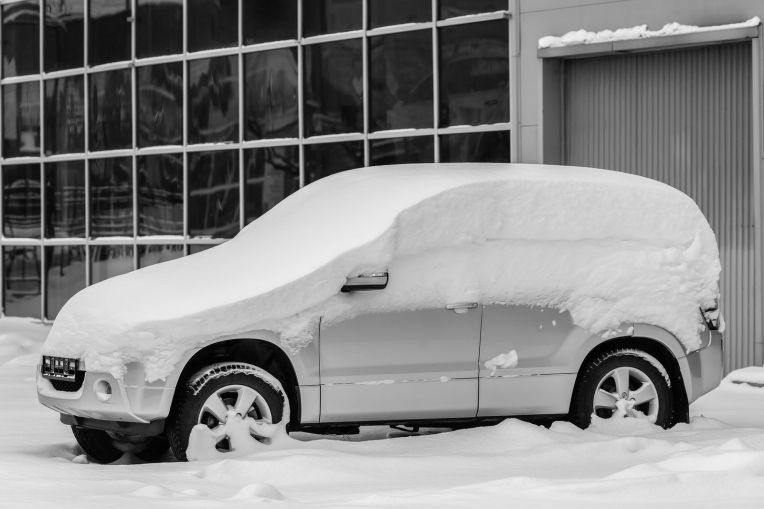
In the cold, a battery delivers less current just when a cold engine needs more to start. At around -18 °C it has only about half of its normal capacity left, so frost exposes a weakness that has been building since the summer heat. In ADAC's breakdown statistics the battery is the most common reason a car will not start, accounting for almost one call-out in two.
A battery usually lasts 4-6 years. If yours is more than three years old, check it every autumn. A voltmeter gives you a first indication. Measure when the car has stood for at least a few hours, because right after a drive the reading is too high:
- above 12.4 V - fine;
- 12.0-12.4 V - it should be charged;
- below 12.0 V - it must be charged.
A fully charged standard battery reads about 12.7 V, an AGM battery about 12.9 V. A voltmeter only shows the state of charge, though, not whether the battery can still start a cold engine. That is checked with a battery tester, which every garage has.
You can also spot a weak battery without any tools:
- the engine turns over more slowly than before or starts reluctantly;
- the lights dim or the radio switches off when you start the car;
- with the engine off, the dipped headlights fade noticeably after a short while;
- the start-stop system stops switching the engine off at junctions.
2. Recharge or replace
If the battery is fairly new and has simply run flat, a recharge is enough. If it is old, or soon drops below 12 V again after charging, you need a new one. A battery with a damaged or swollen case is always replaced.
In winter, short trips are what drain a battery most often. Heated seats and windows, the blower and the lights use more than the alternator can put back on a short drive. Take a longer drive at least once a month, and if the car stands a lot, connect the battery to a charger once or twice a quarter or keep it on a maintenance charger.
The charger should be fully automatic, with protection against short circuits and reverse polarity, and temperature compensation helps in winter. One night is usually enough for a charge. Connect the red clamp to the positive terminal and the black one to the car's earth point, and only then plug the charger into the socket.
In frost, remember two more things. A battery only accepts a charge above 0 °C, so one taken out of a cold car has to warm up first. A fully charged battery does not freeze even in hard frost, but a flat one can freeze just a few degrees below zero. Do not charge or jump-start a frozen battery until it has thawed, as it can burst.
3. Which battery to choose
The car's owner's manual or the label on the old battery tells you which battery is right. The new one needs:
- the same case size and terminal layout, otherwise the cables may not reach;
- a capacity (Ah) as close as possible to what the car maker specifies;
- a cranking current (A EN) no lower than the maker specifies;
- for a start-stop car, an EFB or AGM battery.
It is easiest to start from the old battery's data. In the case code finder you will find L-series, LB and JIS codes with their dimensions in millimetres, and in the car battery catalogue you can filter by capacity and cranking current. If the label on the old battery is no longer readable, there are links to the battery makers' finders on the same page.
Compare cranking current within one standard only, because the American SAE figure for the same battery differs from the European EN one, and our catalogue lists the current to EN. A cheaper battery with a lower current or capacity only saves money at the till, because on a cold morning it is the first to run out of reserve. If the car spends the winter outdoors, a little extra current above the maker's figure is money well spent.
Start-stop cars: AGM or EFB
A standard battery fails within a few months in a start-stop car, and the start-stop system stops working. The rule is simple:
- if the car came with AGM, only AGM will do;
- if the car came with EFB, EFB or AGM will do.
An EFB battery withstands about twice as many charge cycles as a standard one, so it can pay off even in a car without start-stop if it is driven mostly on short trips. You will find AGM and EFB batteries in the start-stop section of the battery page.
Does the new battery need registering
On many modern cars a new battery has to be registered with a diagnostic tool, otherwise start-stop and comfort features may work only partly. According to VARTA's list this is required on, for example, Audi, BMW, Mini, Škoda and Volkswagen cars, whereas Toyota, Volvo, Renault and Peugeot adapt to the new battery on their own. For your own car, the owner's manual or a garage will give you the exact answer.
Fitting the new battery and disposing of the old one
If you replace it yourself, disconnect the negative (black) terminal first and reconnect it last. The new battery must be properly secured, and this is also checked at the roadworthiness test. The test does not measure starting power, though, so passing it tells you nothing about whether the battery will last through January.
An old battery must not go in household waste, because it contains lead. Take it to a battery recycling point.
If the car will not start in the frost
Before starting, switch off everything you do not need: the blower, heating, radio and unnecessary lights. If the car has a manual gearbox, depress the clutch. If that does not help, jump-start the engine in this order:
- Connect the red lead to the positive terminal of the flat battery, then to the positive terminal of the donor car's battery.
- Connect the black lead to the negative terminal of the donor car's battery, then to the earth point of the car with the flat battery or to an unpainted metal part of its engine, not to the battery itself.
- If the engine does not start, wait a minute and try again. After the third failed attempt, call for help.
- Once the engine is running, switch on the blower and lights, then disconnect the leads in reverse order.
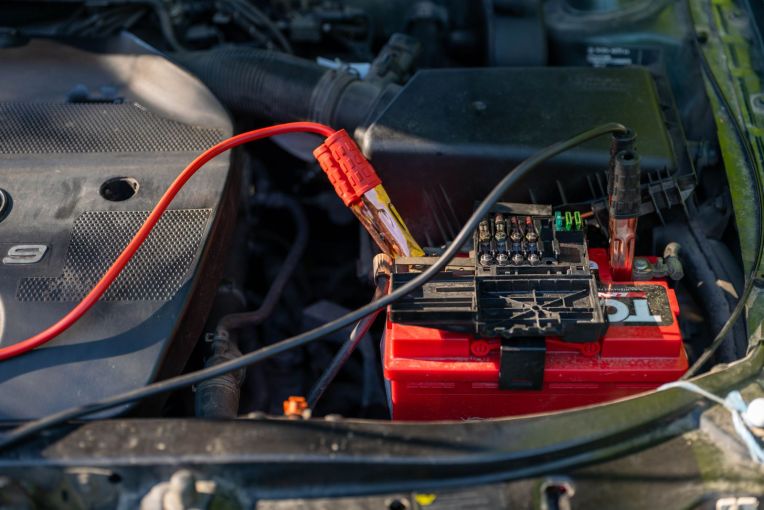
The leads need a cross-section of at least 25 mm² and a length of 2 m. After a difficult start, drive for at least half an hour or charge the battery with a charger. Electric cars and hybrids also have a 12 V battery that can run flat, but makers usually advise against using them to jump-start another car, so check the owner's manual first.
What to do before December
- Have a battery older than three years checked with a tester at a garage.
- If the resting voltage is below 12.4 V, charge the battery.
- If your trips are short, take a longer drive once a month or keep the battery on a charger.
- Choose a new battery by the old one's case, capacity and EN current, and for a start-stop car only EFB or AGM.
In our battery catalogue every battery is listed with its case code and dimensions, capacity and EN current, so you can find the right one before you buy. You can add winter tyres to the same order.