Which size comes on which trim
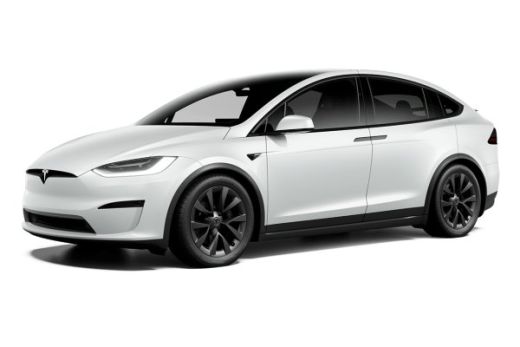
The first-generation 20-inch set, fitted from 2015 to 2021, is 255/45 R20 at the front and 275/45 R20 at the rear, with load index 105 and speed rating V. After the 2021 update the front tyre grew wider: 265/45 R20 with index 108, while the rear stayed at 275/45 R20. The 22-inch set, 265/35 R22 and 285/35 R22 with index 102 W, is on the list for the whole production run, on the 75D and Long Range as well as on the Performance and Plaid.
The front and rear sizes are different
All three factory combinations are staggered across the axles, with the wider tyre at the rear. Two practical things follow from that. A set always consists of two tyres in one size and two in another, so a seasonal changeover means buying two sizes as well. Tyres cannot be moved from front to rear to even out wear, which leaves only a side-to-side swap within the same axle, and only if the tread pattern is not directional.
The rear axle also wears faster. Auto Bild writes that instant torque together with the higher weight wears an electric car's tyres down faster than on a petrol or diesel car, and Continental puts it the same way. The only Model X set without this staggered layout is the additional 265/50 R19 set for 2015-2021 cars: there all four tyres are the same and can be rotated through all four positions.
Why the load index is so high
ADAC notes that on passenger cars the load index is usually between 88 and 99. On the Model X list it starts at 101 and goes up to 110. The reason is mass: Auto Bild estimates that an electric car weighs roughly 200-300 kg more than a comparable car with a combustion engine.
The figure is tied to the specific size, not to the car as a whole, so it must not be carried over from one size to another: 255/45 R20 requires 105, the wider 265/45 R20 already 108, and 265/50 R19 as much as 110. How much a single step matters is shown by Continental's announcement of the HL marking - in one and the same size an SL casing carries 670 kg, XL 750 kg and HL 825 kg. The requirement is read off the tyre sidewall, the sticker on the driver's door pillar and the owner's manual; the registration document holds no tyre data.
20 or 22 inches
The 22-inch set has a low sidewall, a 35 series on both axles, so a pothole damages both the tyre and the rim sooner and road bumps come through more inside the car. Diameter is not, however, the main thing that decides braking. In a TÜV Süd test on a BMW i4 the same Goodyear Eagle F1 Asymmetric 6 stopped from 80 km/h in 31.4 m on 18 inches and 31.5 m on 19 inches, while a cheap 19-inch tyre needed 41.1 m. The tyre model mattered more than the diameter.
For winter, owners therefore tend to go back to 20 inches or to the additional 19-inch set, where the taller sidewall protects the rim on rougher surfaces. The choice at 22 inches is narrower than at 20 inches, especially in winter tyres.
Speed rating
On the early 20-inch set the requirement is V, for 265/45 R20 the list shows both V and W, and 265/35 R22 requires W. Y appears only on the additional 285/30 R22 and 305/30 R22 set, which the list allows for the Performance, P100D and Plaid trims. In Latvia it is the car's design top speed that is binding, not the road speed limit, so you must not go below the rating given in the table.
What T0, T1 and T2 mean
Tesla-approved tyres are marked with the letter T on the sidewall. T0 is the first approved version, and when the tyre is revised with a new construction or technology, it gets T1, T2 and so on. The number refers to the tyre model, not to the car: Tesla itself explains that one manufacturer's T1 tyre is newer than the same manufacturer's T0 tyre, but not necessarily newer than another manufacturer's T0 tyre. The widely repeated scheme that divides T0, T1 and T2 between car models is therefore wrong. Tesla's own replacement tyre tables list T0, T1 and T2 tyres for one and the same car.
Tesla does not publish anywhere exactly how the T0 and T1 versions of the same model differ. What is known is that the tyres are developed together with the tyre manufacturers and that most approved tyres can only be bought from Tesla itself. They are not mandatory. Tesla does recommend these tyres, citing lower road noise and better handling, but neither the warranty terms nor anything else makes that choice a condition. ADAC takes the same position: what matters is the size and load index approved for the particular car, and at least in the case of premium manufacturers any tyre with matching specifications can be considered suitable. A tyre without the T marking may have higher rolling resistance and therefore less range, as well as more noise in the cabin.
Why an approved tyre is often V or W rather than Y
The speed rating indicates the maximum speed at which the tyre may be driven: V is 240 km/h, W is 270 km/h and Y is 300 km/h. ADAC explains that above the H rating a tyre's load capacity falls as speed rises, so a higher rating calls for a casing that withstands more heat and sustained load. On an electric car's tyre that works against both of the main goals. Manufacturers point out that when a tyre is optimised for electric cars the priority is range, while the weight of the battery calls for a higher load index, XL or HL. A stiffer and heavier Y-class construction makes both harder, and for most Tesla models the design speed stays below the W limit.
TPMS when changing tyres or wheels
Tesla uses two generations of pressure sensor that are not compatible with each other: 433 MHz radio in early cars, Bluetooth Low Energy in newer ones. That becomes important when buying a second set of wheels with its own sensors. After a wheel change the sensors relearn by themselves if you drive faster than 25 km/h for a few minutes; older manuals give ten minutes for the same procedure. When different tyres are fitted to the same rims, nothing needs to be done. Manual relearning on the touchscreen exists only in those cars that do not have the automatic version. The manual warns that after a tyre change outside a Tesla service centre the sensor may not work until Tesla carries out the installation procedure, and that the sensor battery cannot be replaced - the whole sensor is replaced. In Latvia this is not merely a question of convenience. On category M1 cars first registered on or after 1 January 2018 with a manufacturer-fitted TPMS, the system has to work, and missing sensors or a lit warning light are a defect at the roadworthiness test.
Winter tyres in Latvia
From 1 December to 1 March a car with a gross weight of no more than 3.5 t must have winter tyres. The roadworthiness rules require the mountain and snowflake marking (3PMSF); winter tyres carry it, but the M+S designation alone is no substitute and, since 1 October 2024, no longer counts during the mandatory period. Tread depth in this period must be at least 4 mm. At the test 3.0 to 4.0 mm is a major defect, below 3.0 mm already a dangerous one. Studded tyres are permitted from 1 October to 1 May, so the permitted period is wider at both ends than the mandatory one.
These requirements also cover the speed rating. A tyre's speed category and load index may not fall short of the car's technical parameters, and what counts is the car's own design maximum speed, not the road speed limit. A winter tyre rated Q or T on a car with a design speed of 200 km/h or more is a major defect at the test.
Where to find your size
The size, load index and speed rating are written on the tyre sidewall itself. The size and pressure specified by the manufacturer can be found on the sticker in the driver's door frame, in the owner's manual and, on cars with a combustion engine, on the fuel filler cap as well. The registration certificate carries no tyre data, and the technical passport was replaced long ago, so there is no point looking in either.