
How to choose
Metal chains or textile snow socks
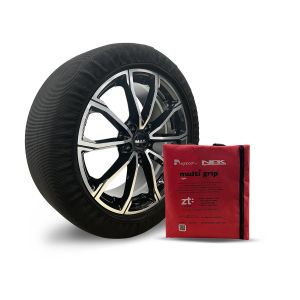
Classic snow chains are made of metal links. ADAC rates them as the best all-round solution, and one that also stands up to wear well enough. Textile snow chains, or snow socks, are made of technical fabric and pulled over the tyre like a cover. They are lighter, quieter to drive on and take up less space in the boot. Our range includes NPK Multigrip Light socks. The manufacturer states that they are approved to the European standard EN 16662-1 and were tested against metal chains for braking and accelerating on ice and for climbing a hill on snow.
Socks make sense if you need chains only now and then: a trip to the mountains, an uncleared yard, a steep driveway. NPK also recommends them for cars that are not designed for metal chains, for example where there is little space in the wheel arch. Their weak point is tarmac. In NPK's tests the socks covered 150 km on tarmac at up to 50 km/h, and the Multigrip warranty does not cover prolonged driving on tarmac. If you often drive on snowy mountain roads, consider metal chains.
The size is set by the tyre, not just the wheel
Each size of chains and socks has its own list of tyre sizes. For example, one NPK size fits both 205/55 R16 and 225/45 R17 tyres, because their circumference and width are similar. Read the size on the tyre sidewall - width, aspect ratio and diameter - and compare it with the size list in the product description. If your size is not there, ask us before you buy rather than taking the nearest one. Check your car's owner's manual as well. It often says which wheel sizes chains are allowed on, and some cars with tight wheel arches may only take chains with thinner links, or none at all.
Which wheels, and how fast to drive
Chains or socks go on both wheels of the driven axle: at the front on a front-wheel-drive car, at the rear on a rear-wheel-drive car. On an all-wheel-drive car the right axle is set by the manufacturer, and you will find it in the owner's manual. The maximum speed is set by the maker of the product. With chains you can usually drive at up to 50 km/h, and that is exactly what NPK allows for its socks too. Once the road under your wheels is clear tarmac again, take them off - ADAC warns that otherwise both the chains and the road surface are damaged. Another ADAC tip: fit them for the first time at home, in dry weather. Learning how on the roadside in the snow is much harder.
Rules in Latvia and abroad
In Latvia snow chains are not compulsory, and there are no specific rules on using them. Other countries are different:
- In France, since 1 November 2021, in designated mountain areas from 1 November to 31 March you must either drive on four 3PMSF tyres or carry metal or textile chains for at least two driven wheels. Socks are an accepted alternative there, and winter tyres with the 3PMSF marking already meet the requirement.
- In Austria, according to ADAC, roads with a "snow chains compulsory" sign require steel chains, so socks may not meet the requirement there.
- In Italy there are no uniform national rules, and winter equipment requirements are set by the provinces.
Rules change, so check the current requirements of your destination country before you travel. Do not count on snow socks being accepted everywhere.