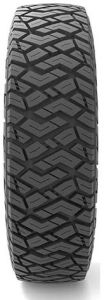
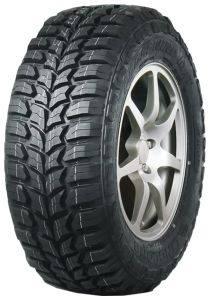
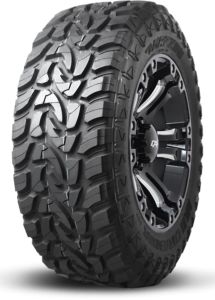
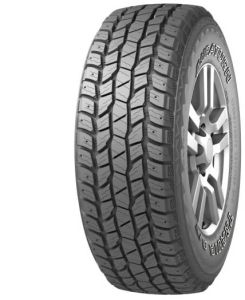
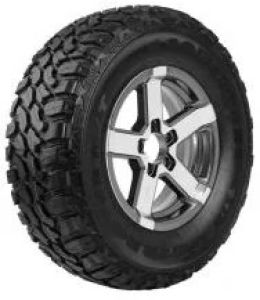
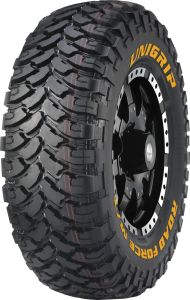
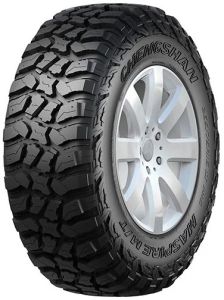
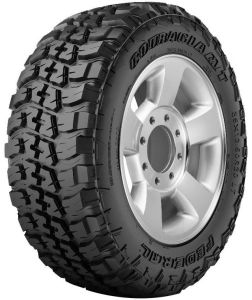
Mud-Terrain tyres

The most aggressive off-road class for serious off-roading - mud, rocks and sand.

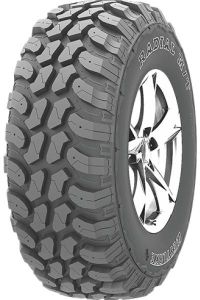
If your vehicle spends more time on muddy forest tracks, in quarries or in sand than on tarmac, you are in the right place. Mud-Terrain tyres are made for 4x4 off-roaders, pickups and SUVs that genuinely go off-road. They are the choice of hunters, foresters and off-road enthusiasts. The large tread blocks and wide gaps let the tyre bite into soft ground and self-clean. Below you will find our M/T models in a wide range of sizes.

58 tyre models available
Filter by size

Find your size

Classic Radial M/T
1 size
M/T
from 59,00 € /tyre
T01
1 size
M/T
from 89,00 € /tyre
Couragia M/T
1 size
M/T
from 123,00 € /tyre
Conqueror M/T MT-1
1 size
M/T
from 194,00 € /tyre
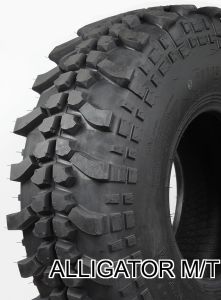
Alligator
1 size
M/T
from 97,00 € /tyre
Mud Contender
1 size
M/T
from 141,00 € /tyre
Primemaster M/T II
1 size
M/T
from 110,00 € /tyre
GN3000 M/T
1 size
M/T
from 166,00 € /tyre
Thruster
1 size
M/T
from 241,00 € /tyre
CF3000J
1 size
M/T
from 95,00 € /tyre

Where Mud-Terrain fits among other off-road tyres

Picture the range of tyres as a line. At one end are ordinary road and SUV tyres - quiet, economical, but practically hopeless in mud. At the other end sits the Mud-Terrain: a large open tread, wide gaps and often tough 3-ply sidewalls to resist sharp rocks. In between is the All-Terrain (A/T), a compromise of roughly 80% road and 20% off-road, with plenty of sipes that give a smoother ride and longer life. The M/T is the opposite: roughly 20% road, 80% off-road. Some brands also offer the Rugged-Terrain (R/T) as a hybrid between the two.

The practical question is simple: how often are you really off-road. If the answer is "rarely", an A/T will serve you better. But if mud and forest tracks are your daily routine, an M/T pays off. Before you buy, think through these points:

  • Share of tarmac driving. An M/T shines off-road, but on the motorway it roars and wears faster. The more you drive on the road, the less sense a mud tyre makes.
  • Noise and comfort. The large blocks and wide gaps create a hum that grows with speed - worth knowing before a long motorway drive.
  • Wear and fuel. The soft compound wears faster on tarmac, and the greater weight pushes up fuel consumption; for many M/T models the manufacturers give no mileage warranty.
  • Winter grip. Because of the sparse siping, the braking distance on wet and icy tarmac is longer than with A/T or winter tyres.
  • Size and load. Mud tyres tend to be fitted on lifted vehicles and larger rims, so check the rim diameter and the load index. Our range covers R13 to R26.

Our M/T range includes both specialist off-road makers such as Comforser, Accelera and Lakesea, and more familiar names like Cooper and Kumho.

A word on the Baltic winter: from 1 December to 1 March, passenger cars in Latvia are required to run tyres with the 3PMSF marking and at least 4 mm of tread (CSDD regulations), and tyres marked only M+S are no longer allowed in winter. Some of our M/T models carry the 3PMSF marking - those are the ones that work as your only set for winter, while the rest need a separate winter set.

Frequently asked questions

Yes, just not very comfortably. On tarmac, M/T tyres roar, use more fuel and wear faster than road or A/T tyres. If most of your driving is on the motorway, an A/T will be the more practical choice.
M+S (Mud and Snow) is a manufacturer's self-declared marking with no standardised test. The 3PMSF, or mountain-and-snowflake symbol, confirms that the tyre has passed a snow braking test. In Latvia, only tyres with 3PMSF are suitable in winter, not those that carry M+S alone.
The wide gaps let the tyre self-clean - as it turns, the blocks fling out trapped mud and keep grip. Without this, the tread would quickly clog in mud and the tyre would start to slip.
A simple rule of thumb: if you get off-road less often than you're on tarmac, choose A/T. Mud-Terrain only pays off if mud and rocks are your everyday route.
Yes - the tyre choice is determined by size and load index, not the type of engine. For electric off-roaders, pay attention to the load index, as they are often heavier than comparable cars with a combustion engine.